

How to Avoid ATM Fees Abroad (Without Carrying a Brick of Cash)
By  Ignas Simkus|Last updated: 7 August 2026|How we test
Cash still runs half the world’s best travel moments, and airports and tourist strips price that dependency. I have paid the 220-baht Thai ATM toll enough times to have a system now: the right card, the right machine, the right buttons, the right amount. Here it is.
Article Summary
- Three fee layers: the machine’s operator fee, the DCC rate trap, your own bank’s charges
- The routine: right card, bank-attached ATM, decline conversion, fewer bigger withdrawals
- Tested example: Thai bank ATMs charge foreign cards 220 baht, some 250-350
- Your side: a travel card with a real free-withdrawal allowance
Where the money actually leaks
An expensive withdrawal abroad is three separate decisions going wrong at once. The operator fee, charged by the machine’s owner: our tested example is Thailand’s flat 220 baht at most bank ATMs, 250-350 at some, roughly $6-10 per withdrawal regardless of amount. The DCC trap, where the machine offers to convert at its own padded rate, the same scam we break down in the DCC guide. And your own bank’s foreign-ATM fee plus FX markup, the only layer you can fix before flying.
Pick the machine like a local
Bank-attached ATMs, physically at a branch, carry the standard fee and the standard security. The independent machines wrapped in convenience branding (Euronet across Europe, assorted airport units everywhere) run higher operator fees and the most aggressive conversion screens; treat them as the vending machines they are. In a genuinely fee-heavy country, the counter move is inside the bank: some banks waive the machine fee for over-the-counter withdrawals with a passport, slower, but real.
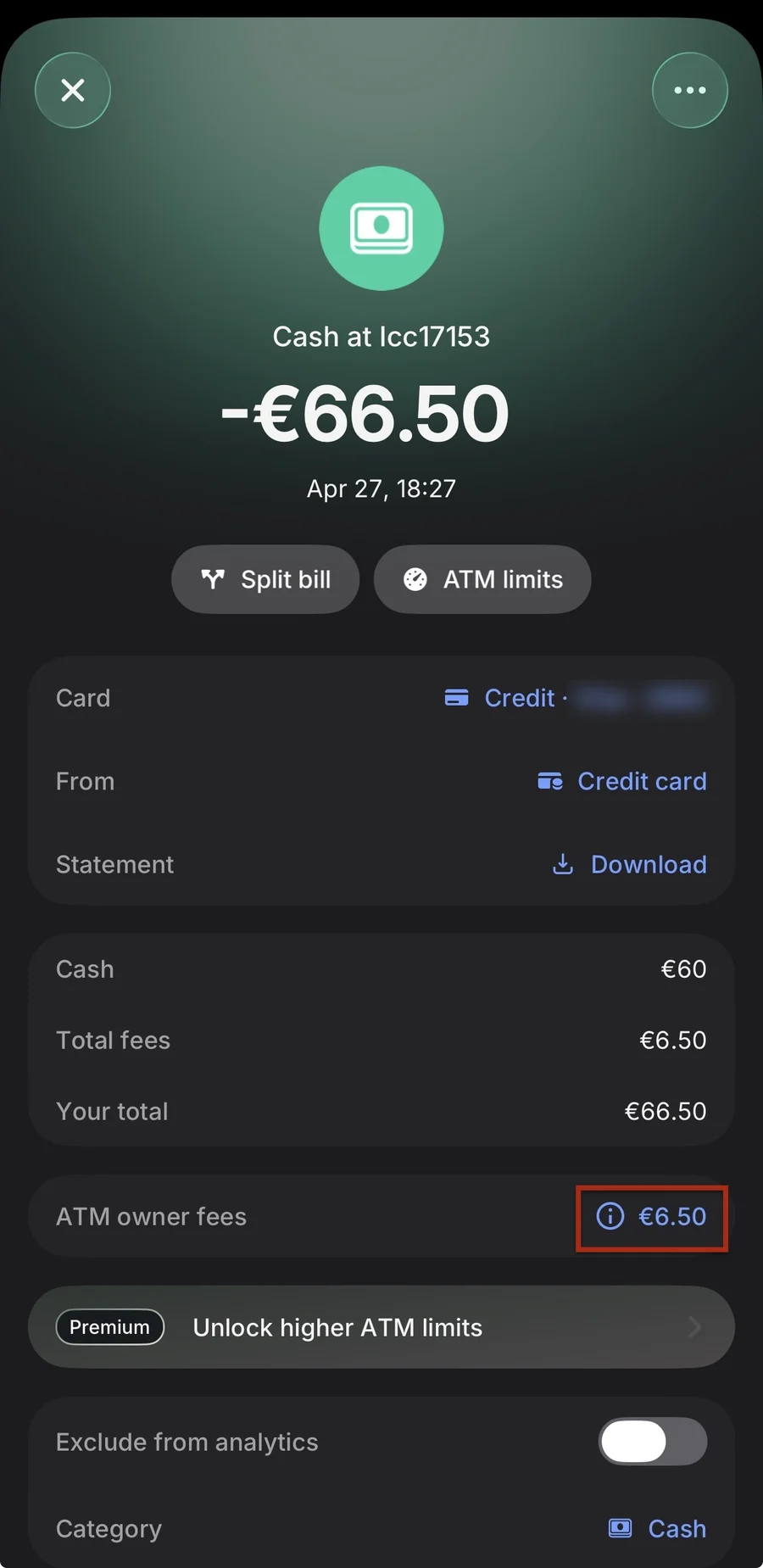
Do the arithmetic on that receipt once and the routine writes itself: €6.50 of operator fee on €60 of cash is 10.8%. The same €6.50 on a €300 withdrawal is 2.2%. Same machine, same fee, five times less pain, which is the entire case for fewer, larger withdrawals from better machines.
The four-button routine
Insert card. Decline the conversion, the screen will call your home currency convenient; the local currency is the real price, per the DCC rule. Refuse the “with receipt conversion” re-ask some machines sneak in. Withdraw a larger amount, fewer times, a flat 220-baht fee is 4.4% of a 5,000-baht withdrawal but 1.1% of 20,000. And check the app immediately; a good travel card shows the exact conversion within seconds, which is your audit trail.
Fix your side before you fly
The home-bank layer is solved by carrying a card built for this: my own setup uses Revolut for spending with its monthly free-ATM allowance, and the allowance maths in our travel cards guide covers the rest of the field. Whatever you carry, know your free allowance, know the percentage after it, and split large cash needs across the month. And keep the emergency rule from our banking-abroad guide: a second card, different network, different pocket.
The Euronet question, answered plainly
Those bright blue-and-yellow machines colonising every European tourist street are independent ATMs: they belong to no bank, they exist to monetise convenience, and they stack the layers harder than anyone. Typical pattern per independent-ATM trackers like Monito’s Euronet guide: a fixed operator fee of several euros regardless of amount, plus the most aggressive DCC screens in the business, dressed in graphs that make the terrible rate look official. The counter-move costs nothing: walk the extra hundred metres to a machine physically attached to a bank branch. Bank-owned ATMs charge lower or no operator fees in most of Europe, and their DCC screens, where they exist, are less theatrical.
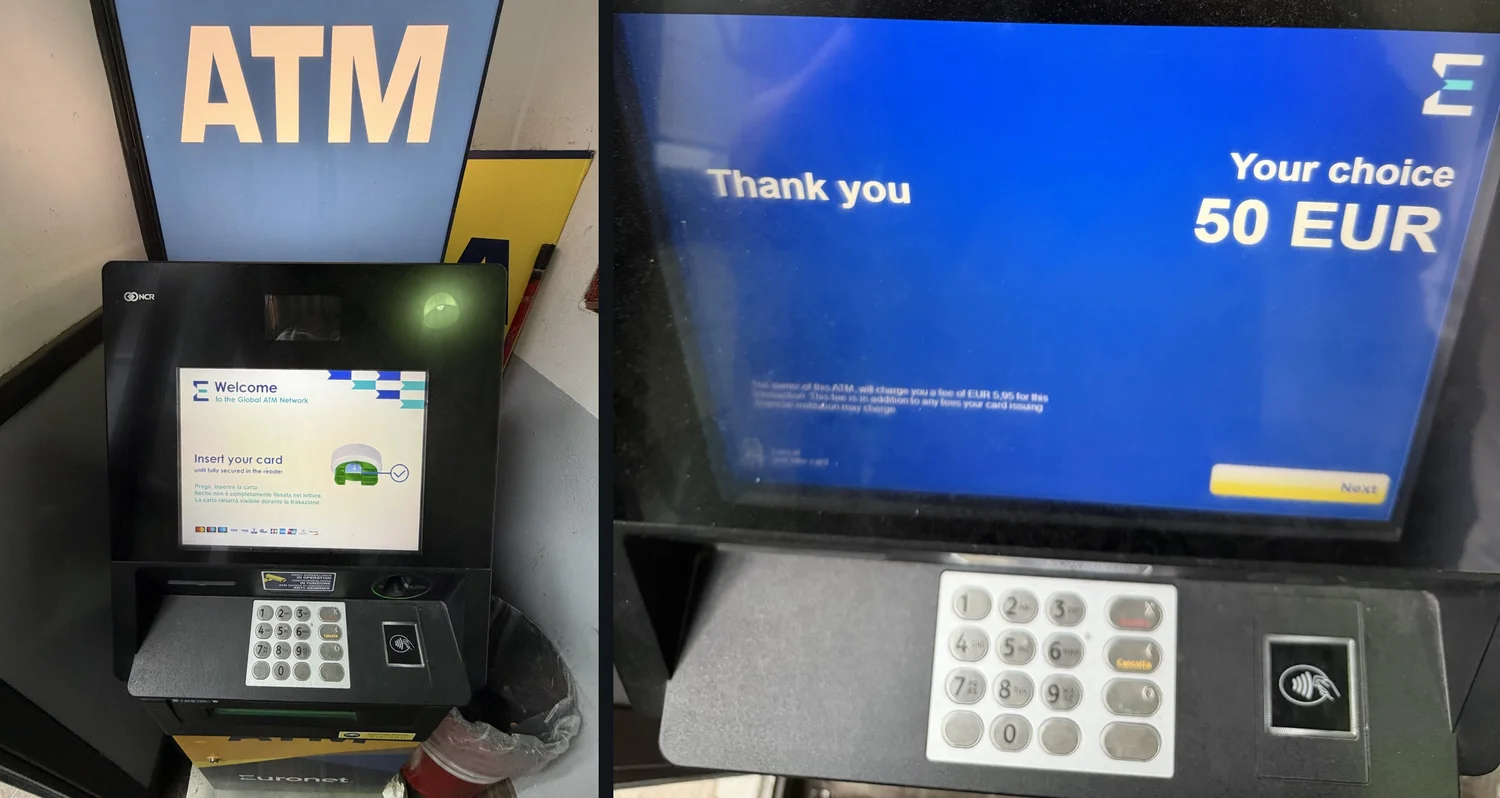
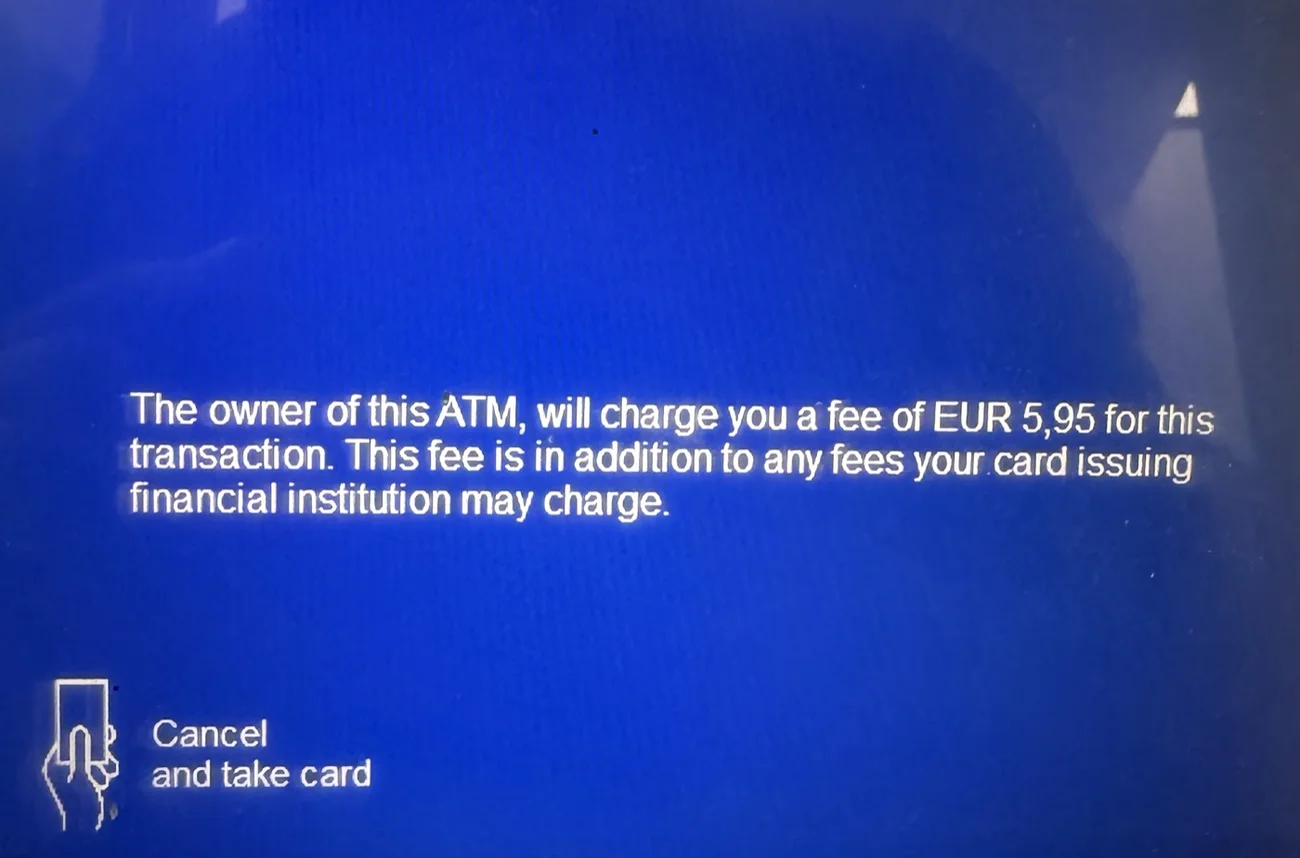
And because these machines write their own best evidence: the one I tested wanted EUR 5.95 on a 50-euro withdrawal, 11.9%, disclosed in exactly the small type nobody reads, with the standard reminder that your own bank’s fees stack on top. The same 5.95 on a 250-euro withdrawal would be 2.4%, which is the entire fewer-larger-withdrawals argument on one screen.
Two more structural saves. If your home bank belongs to an alliance (Bank of America’s Global ATM Alliance is the classic example), its partner banks abroad waive the operator layer entirely, worth one search before flying. And app-first cards keep the home-bank layer at zero inside their allowances: the free tiers of the cards in our travel-cards lineup give you €200-250 a month of withdrawals where the only possible fee left is the machine’s own.
| Getting €300 over two weeks | Operator fees paid | Effective cost |
|---|---|---|
| 6 x €50 at a €6.50 tourist-street machine | €39 | 13% |
| 2 x €150 at the same machine | €13 | 4.3% |
| 2 x €150 at a bank-owned ATM (€0-2 typical) | €0-4 | 0-1.3% |
How much cash to actually carry
Less than habit says. Card acceptance has swallowed most of urban Asia and nearly all of Europe; the cash-only zone is markets, small food, tuk-tuks and temples. My own pattern is one meaningful withdrawal on arrival, enough for several cash-days, then top-ups only when the wallet actually thins. Airport ATMs are for emergencies only: worst fees, worst rates, longest queues. Twenty minutes of patience until town is the cheapest financial product in travel.
FAQ
Why did the ATM charge me twice?
Two independent layers: the machine owner’s operator fee at the slot, and your own bank’s foreign-ATM fee on the statement. Accept DCC on top and one withdrawal carries three charges. Fix the layers you control: your card and that conversion button.
Are airport ATMs worse than city ATMs?
Same machines, fatter fees airside, routinely. Unless you are landing cashless in a cash-first country, walk past them and withdraw in town.
Is it better to withdraw a lot at once?
With fixed operator fees, yes: one 200-euro withdrawal beats four fifties by three whole fees. Balance that against walking around with cash you would hate to lose; my rule is a few days’ needs per pull.