

Revolut Review for Travellers (2026): My Daily Card, Honestly
By  Ignas Simkus|Last updated: 3 August 2026|How we test
Revolut is the card I actually pay with, in something like a dozen countries a year. This review is the version I would give a friend: what makes it the most complete travel money app ever built, and the two catches, weekends and tiers, you manage rather than suffer.
Article Summary
- Best for: the traveller who wants one card that does everything
- The rate: mid-market on weekdays; 1% weekend markup on the free plan (0.5% on Plus, none from Premium up)
- The travel kit: auto travel mode, virtual cards, instant freeze, in-app eSIM
- Know your tier: free-conversion and ATM allowances depend on your plan
Why it became my daily card
Half of each year on the road filters banking apps brutally, and Revolut is the one that stayed in my pocket. Weekday conversions at the interbank rate. A travel mode that detects the country from card spend or location and surfaces the right tools, I covered that screen in our banking-abroad guide. Disposable virtual cards for checkouts I do not trust. A freeze button that works in one second from a beach. Even an in-app eSIM data fallback, which as an eSIM obsessive I rate as genuine insurance.
The weekend rule
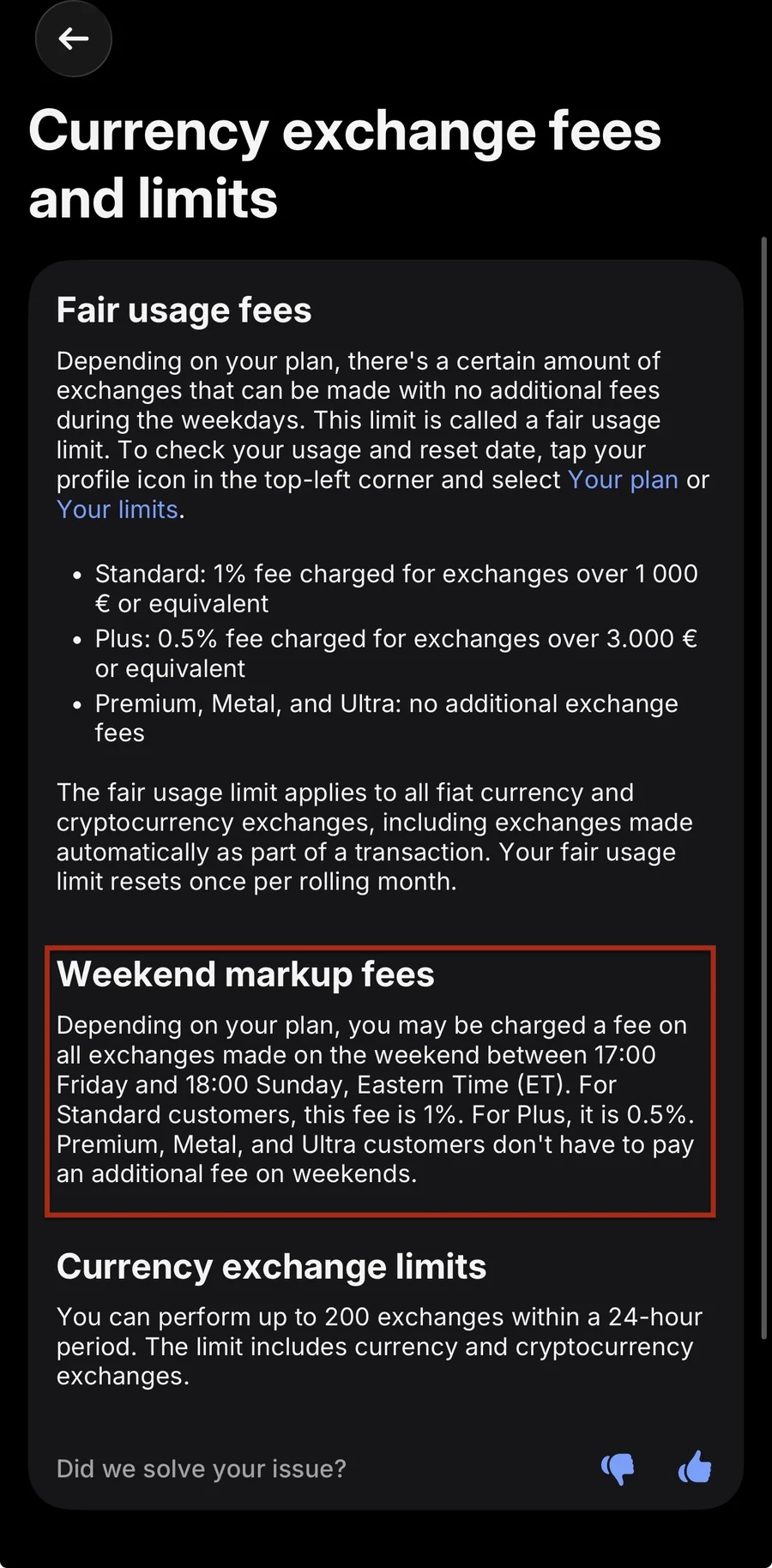
Markets close on weekends, so Revolut adds a markup, around 1% on major currencies, to Saturday and Sunday conversions. The fix is a habit, not a workaround: convert what the weekend needs on Friday, or hold a balance in the local currency. Card payments from an already-held balance dodge the markup entirely. Revolut defines the weekend as 17:00 Friday to 18:00 Sunday Eastern Time, so a European Friday evening already counts. It is the single most important thing to know about the product, and managing it takes less effort than reading this paragraph weekly.
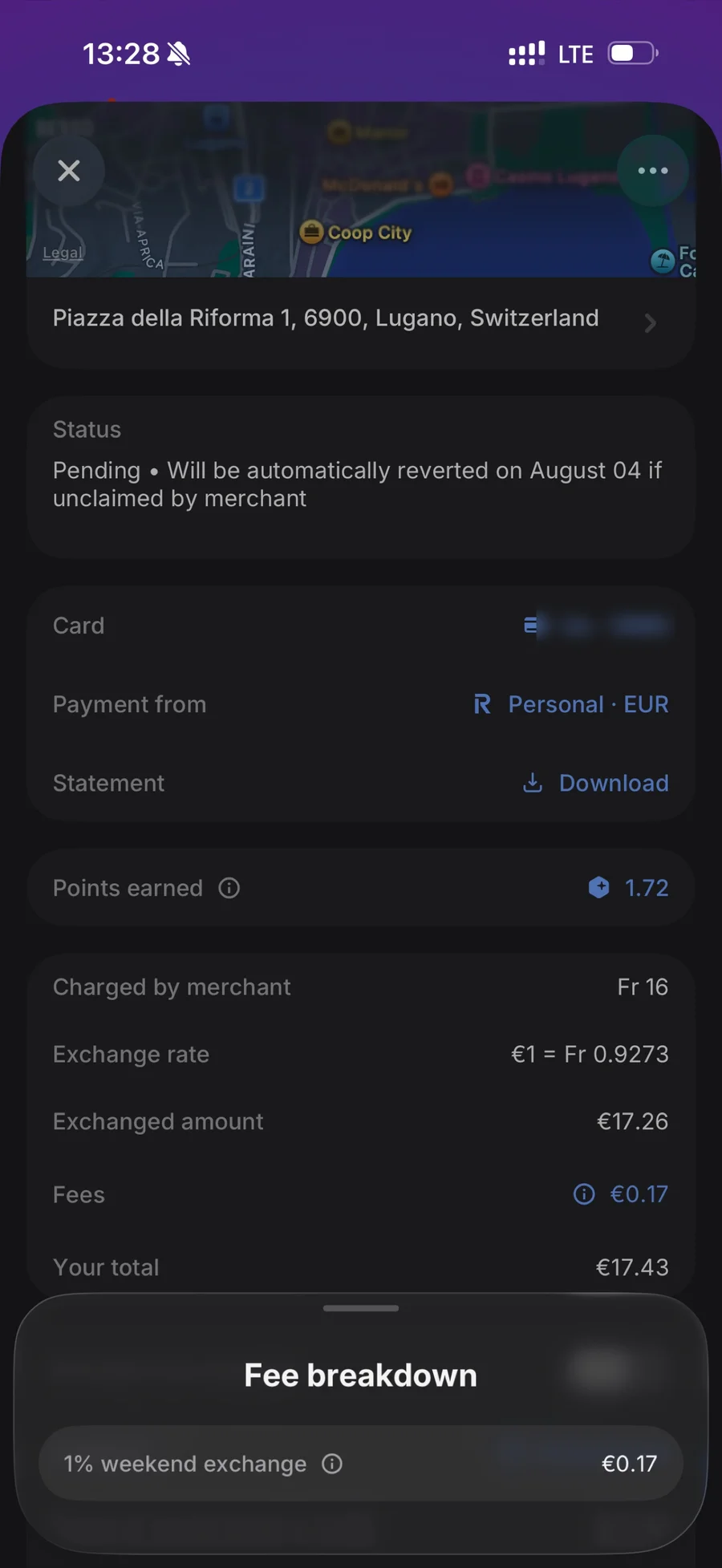
Here is the rule photographed in the wild, from my own card on a Sunday coffee in Lugano: 16 francs charged, converted at the live rate, and a fee line reading exactly “1% weekend exchange, €0.17”. At coffee scale it is seventeen cents; convert a trip’s budget on a Saturday and the same line becomes real money. The Friday habit exists for that line.
Tiers, honestly
The free tier covers a light traveller: fee-free card spending abroad, a monthly free-conversion allowance, and a modest free ATM allowance before a small percentage kicks in. Paid tiers raise those allowances and add the holiday-brochure extras, travel insurance, lounge access on delays, better limits. My honest read after years inside the app: pay for a tier if the allowances match your volume, ignore the extras as deciders. On 2026 numbers: the free plan gets €1,000 of fee-free weekday exchange and €200 or five ATM withdrawals a month; Premium (€8.99) makes exchange unlimited and lifts ATM to €400; Metal (€15.99) to €800; Ultra (€65) to €2,000, with a 2% fair-use fee past any of them. The allowances are the product; the perks are garnish.
| Plan (July 2026) | Monthly | Fee-free exchange, Mon-Fri | Fee-free ATM | Weekend FX fee |
|---|---|---|---|---|
| Standard | Free | €1,000/month | €200 or 5 withdrawals | 1% |
| Plus | €2.99 | €1,000-3,000 band | €200 | 0.5% |
| Premium | €8.99 | Unlimited | €400 | None |
| Metal | €15.99 | Unlimited | €800 | None |
| Ultra | €65 | Unlimited | €2,000 | None |
Past any ATM allowance a 2% fair-use fee (minimum €1) applies; past the exchange allowance on free tiers, 1% (0.5% on Plus). Premium and up also bundle global data eSIMs (1 GB, 3 GB and 5 GB a month on Premium, Metal and Ultra respectively), which as an eSIM obsessive I rate as genuinely useful rather than brochure filler.
The frictions nobody puts in ads
Support is chat-first and layered, fine for card issues, slower for account-level problems. Compliance holds, the industry-wide curse of app banks, are rare but real; the fix is keeping a second card (different network, different company) for the week nobody wants. And Revolut’s banking status varies by country: EEA customers sit with Revolut Bank UAB under Lithuania’s €100,000 deposit guarantee, while other jurisdictions differ, worth thirty seconds of checking for your own setup.
The five-minute pre-trip routine
How I actually run this card before every departure, in the order that matters:
- Convert on Thursday or Friday morning. Whatever the trip’s currency is, buy it inside the weekday window; the weekend rule stops existing for people with this habit.
- Check the allowance meters. Plan page shows how much fee-free exchange and ATM room is left this month; a big trip late in the month sometimes argues for one month of Premium instead of overage fees.
- Load the card into the phone wallet. Apple Pay and Google Pay work on day one and survive a lost card; the physical backup lives in the other bag.
- Skim card security settings. Online payments on, contactless on, location security decided deliberately rather than by default; this screen is also where a mid-trip decline gets fixed in thirty seconds.
- Set the fallback. A second card, different company, different network, in a different pocket. Not because Revolut fails often; because nothing should be a single point of failure at 1am abroad.
The banking-licence news that changes the safety question
For years the honest caveat on Revolut was “brilliant app, not a bank where you live”. That caveat has been shrinking. Since March 2026, Revolut operates as a fully licensed UK bank: eligible UK deposits now carry FSCS protection up to £120,000, under the same PRA and FCA supervision as any high-street name. EEA customers have sat with Revolut Bank UAB under Lithuania’s €100,000 deposit guarantee for years. Two footnotes keep the honesty intact: protection covers eligible bank-held balances, not crypto or investments, and customers elsewhere should check their own jurisdiction’s arrangement in-app. The second card in a different company remains my advice, for operational independence rather than solvency fear.
Verdict
Weighing it against Wise specifically? The head-to-head settles which job each app owns.
Get Revolut if
- You travel often and want one card that handles everything
- You will actually use travel mode, virtual cards and instant controls
- You can manage the Friday-conversion habit
Look elsewhere if
- Your conversions are large and frequent, Wise’s flat honesty wins there
- You want a traditional bank relationship with branch recourse
- Weekend spontaneity defines your travel and you refuse the habit
Revolut is the most complete travel money product built to date, my own card says so daily. Pair it with Wise for the conversion-heavy moments, per our money hub, and the fee problem is closed.
FAQ
Do I need a paid Revolut plan for travel?
The free plan travels well if you convert on weekdays and stay inside the allowances. Upgrade when your volume outgrows them; the tier decision is allowances first, insurance and lounges a distant second.
What happens if Revolut freezes my account abroad?
Compliance holds are rare but real across every app bank, and they do not care about your itinerary. The defense is boring: a second card from a different company, on a different network, carried always. I say that as a devoted daily user.
Does Revolut work in the US?
As a visiting cardholder, your existing Revolut works fine, weekday rates and all. Watch the DCC-pushing US terminals and always pick dollars on screen.