


Home»Insurance»Best for digital nomads
Best Travel Insurance for Digital Nomads (2026)
By  Ignas Simkus|Last updated: 8 September 2026|How we test
I buy insurance rarely and deliberately. The nomad market has settled into three credible products whose real differences sit in the fine print, so that is where this guide spends its time.
Article Summary
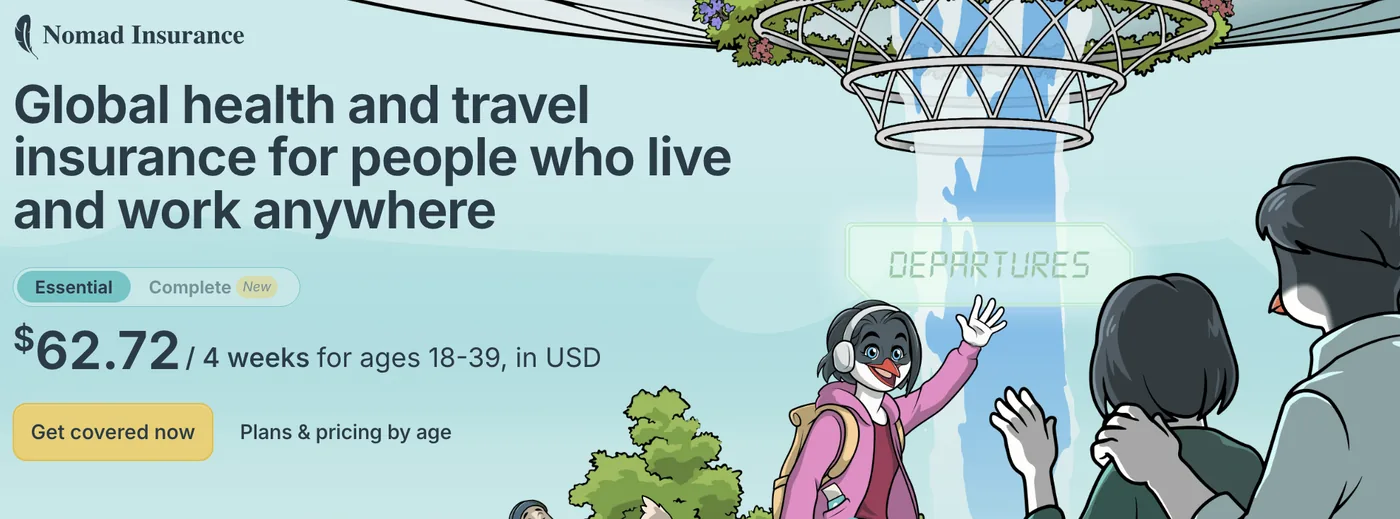
- Best overall: SafetyWing Essential, $62.72 per 4 weeks (ages 18-39) on a rolling subscription
- Best medical depth: Genki Traveler, a €1M ceiling and the category’s friendliest scooter clause
- Best ceilings: Heymondo Long Stay, $2.5M medical on per-trip mechanics
- The real decision: subscription vs per-trip, then three traps: the home-country gap, the $500-per-item gear cap, and the scooter clause
Subscription or per-trip: the decision under everything else
Nomad insurance shopping usually starts with brand names and ends in a spreadsheet nobody finishes. Skip that. One question sorts the whole market: do you want cover that renews until you cancel it, or cover with a start date and an end date?
A subscription (SafetyWing, Genki) suits travel with no return ticket: it charges every four weeks or every month and keeps running through route changes. You can even buy it from a hostel bed abroad. The price of that flexibility is ceilings.
A per-trip policy (Heymondo Long Stay) wants dates. In exchange it carries limits a subscription cannot touch: $2.5 million in medical cover against SafetyWing’s $250,000.
I buy cover per trip myself, when an itinerary gets intensive enough to earn it. The three below are the ones I would shortlist for a nomad year.
How I picked these three
The lineup is short on purpose. I compared the three on five points: medical ceiling, deductible, what happens to a stolen laptop, what happens on a rented scooter, and how each treats your home country. Cheaper products that fall apart on any of those did not make the page.
I owe you two disclosures. I have not filed a medical claim with any of these companies, so I make no promises about their claims desks. And my sourcing is uneven: for SafetyWing I worked from the WorldTrips Description of Coverage, the actual contract behind the product; for Genki and Heymondo I worked from their published plan terms, because I have not yet pulled their full policy documents apart.
The three side by side (September 2026)
The numbers come from each provider’s published pages and, for SafetyWing, the policy document itself, checked September 2026. Two of the three sell by quote only, and the table says so instead of guessing.
| SafetyWing Essential | Genki Traveler | Heymondo Long Stay | |
|---|---|---|---|
| Model | Subscription, renews every 4 weeks | Subscription, 1 to 12 months | Per-trip, 90-day minimum, renewable |
| Price (Sept 2026) | $62.72 per 4 weeks (ages 18-39) | By quote; no public list price, moves with age and region | By quote from your dates, age and destination |
| Medical ceiling | $250,000 | €1,000,000 | $2,500,000 |
| Deductible | $250 per coverage period | €50 per case, waived for inpatient stays | $250 excess, on medical expenses only |
| Baggage and gear | $3,000 per period, $500 per item | Not covered | Up to $1,200, loss or damage |
| Best for | Open-ended travel on a budget | Health-first slowmads and scooter riders | Defined trips and US-heavy itineraries |
Prices and policy terms last verified September 2026.
SafetyWing Essential
The subscription default: cheap enough to keep running all year, with wording that holds no ambushes once you know the caps.
Genki Traveler
A €1M ceiling and the friendliest scooter clause in the category, with zero gear cover by design.
Heymondo Long Stay
$2.5M medical with bills settled directly by the assistance desk, for people who plan in dates and want depth.
SafetyWing Essential: the default, priced like a utility
SafetyWing built this category. Essential runs $62.72 per four weeks for the 18-39 band per SafetyWing’s published pricing (September 2026), climbs by age band, and renews like rent until you stop it. You can buy it after leaving home, which matters more than it sounds.
The wording, from the WorldTrips Description of Coverage: $250,000 overall maximum, a $250 deductible per coverage period, $100,000 lifetime for emergency evacuation, and luggage at $3,000 per period with a $500 per-item cap. The pricing page sells electronics theft cover as an add-on, alongside US cover for non-residents and adventure sports (September 2026). Scooters are covered only if you hold a licence for the class of bike you are riding, with a helmet on and no racing.
The trade-off is the ceiling. $250,000 handles most emergencies across most of Asia and Europe; it is thin for the United States and thin for the worst days anywhere. Our full SafetyWing review reads the rest.
Genki Traveler: health-first, and the scooter exception
Genki made a different bet: insure the body properly and skip everything else. Traveler covers medical treatment up to €1,000,000 with a €50 per-case deductible, waived for inpatient stays, on a subscription of one to twelve months. There is no public list price: the quote moves with your age and the region you select (September 2026), so the only number worth trusting is the one the quote form gives you.
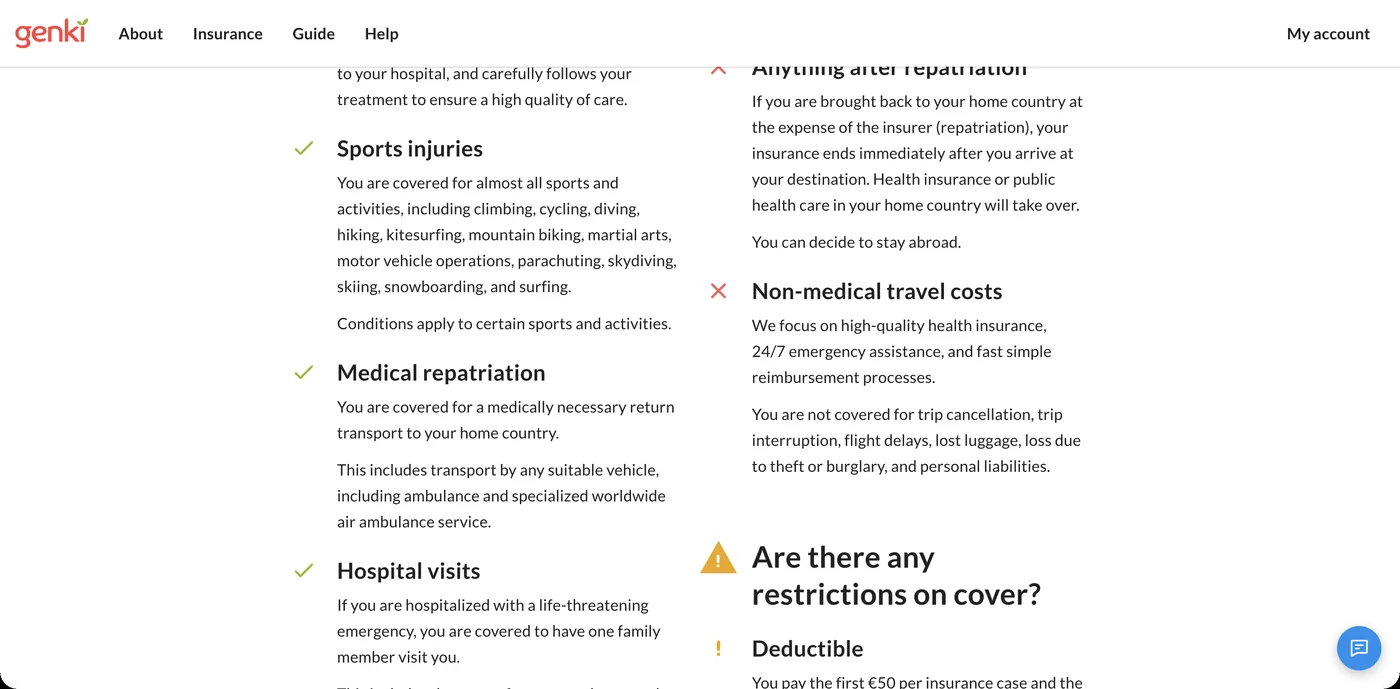
Skip everything else is literal: the product page lists what Traveler will not pay for, including trip cancellation, trip interruption, lost luggage, theft and personal liability. Your laptop is entirely your problem. In exchange, the medical ceiling runs four times SafetyWing’s.
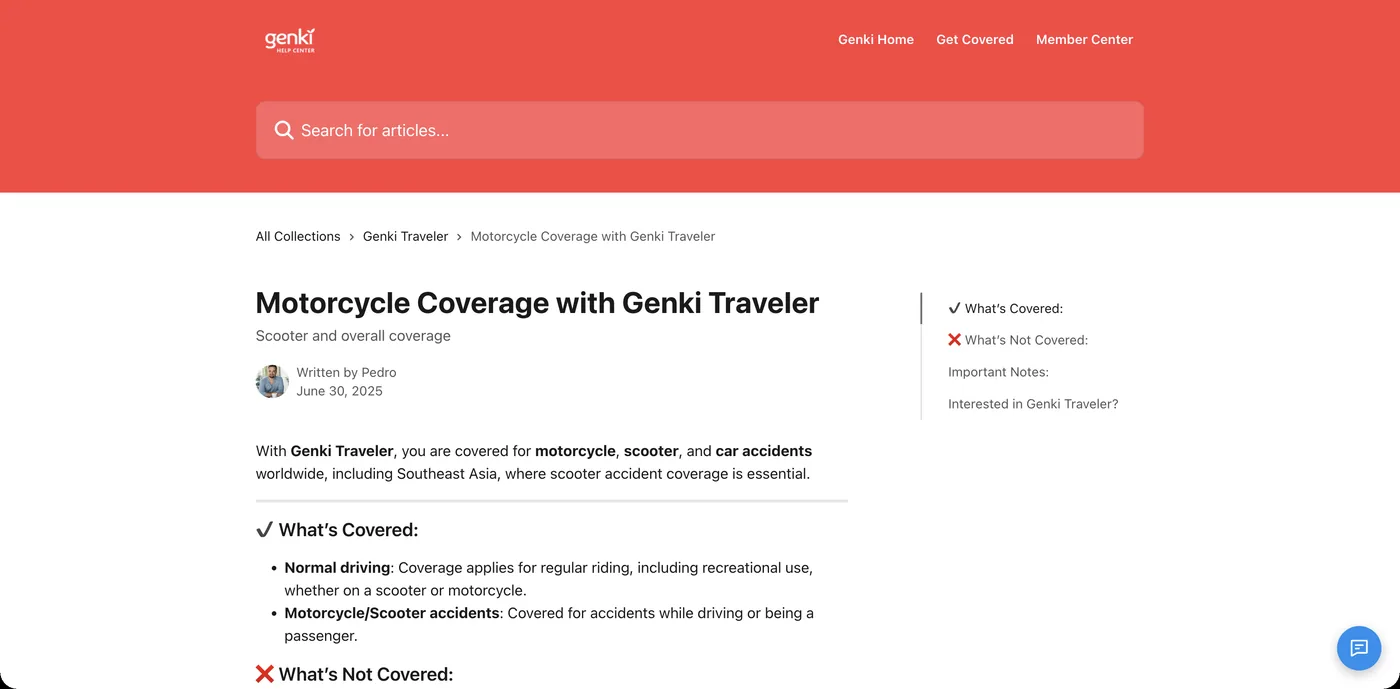
Then the clause this vertical keeps coming back to: per its own policy help pages, Genki covers light motorcycles up to 125cc, 11 kW and 110 km/h without requiring a licence; a helmet stays mandatory and racing stays excluded. Southeast Asia scooter renters should read that clause twice, then read the rental agreement.
Heymondo Long Stay: real ceilings, per-trip mechanics
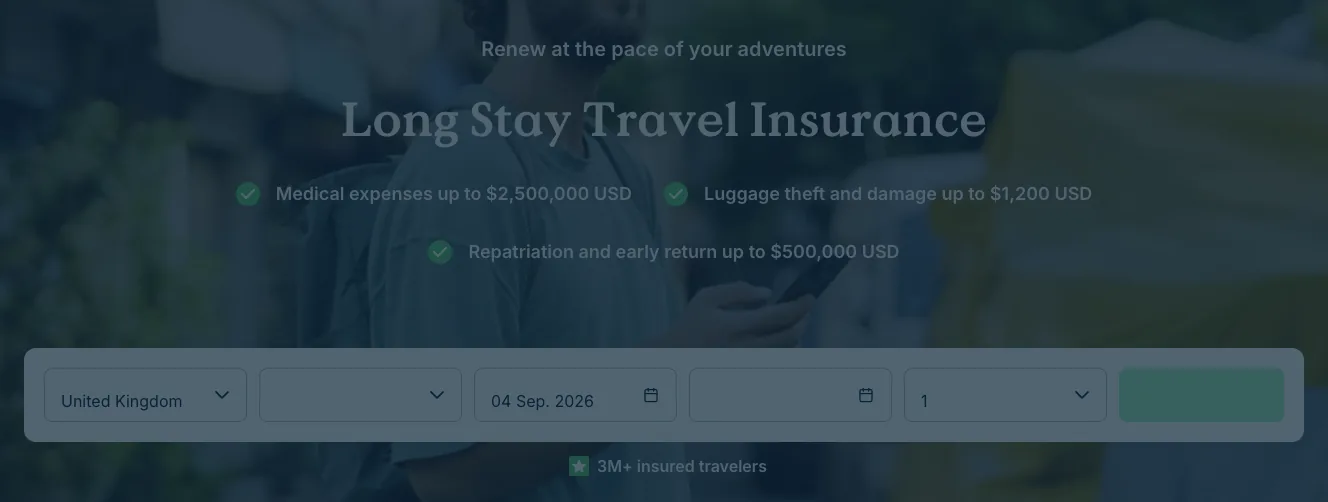
Heymondo prices in dates. Long Stay starts at a 90-day minimum, renews as long as you keep travelling, and shows renewal pricing upfront so the second bill is not a surprise. Like Genki, it has no public list price: the quote is built from the trip you describe (September 2026).
The quote buys depth: up to $2,500,000 in medical cover, repatriation and early-return benefits up to $500,000, and baggage cover up to $1,200 for loss or damage, included in the plan. The assistance platform settles medical bills directly, subject to a $250 excess that applies to medical expenses only. The app carries 24/7 assistance with doctor chat, and at 3am in a country whose health system you cannot read, that button beats any brochure line.
The trade-offs: you need dates, and general customer service keeps European office hours even though the emergency line does not. Heymondo’s standard per-trip plans, which reach $10 million medical ceilings, are a separate product built for defined holidays rather than nomad years.
Three traps that cost nomads real money
Trap one: the home-country gap
Travel medical cover is built around you being away. Policies in this class cap or exclude treatment in your home country, and nomads who cancel domestic health insurance discover this at the worst moment: standing in a clinic at home between trips. SafetyWing Essential includes a short home-visit allowance, 30 days per every 3 months of coverage and 15 when your home country is the US, rather than full home cover, and Genki sells a separate product, Native, for people replacing home insurance for good. Before cancelling anything domestic, count your at-home days in a normal year. More than a visit, and a travel policy is not your health insurance.
Trap two: the $500-per-item gear cap
Gear cover looks generous until you read the caps. SafetyWing’s luggage benefit stops at $500 per item inside a $3,000 per-period limit, and nothing in the coverage document promises replacement cost, which turns a stolen MacBook into a $500 cheque no matter what the laptop cost. Genki does not pretend otherwise: Traveler covers no gear at all. Treat nomad insurance as body insurance and cover the laptop separately, with a gadget policy or a contents rider that travels. An insurer that advertises electronics cover in the headline usually takes it back in the per-item table.
Trap three: the scooter clause
Most travel policies handle scooters the way SafetyWing does: cover applies only if you hold a licence valid for that class of vehicle. A car licence is not a motorbike licence in most places nomads rent bikes, so the traveller on a 150cc rental in Thailand is riding uninsured while holding a policy that says motorbikes are covered. Genki’s no-licence exception up to 125cc is the outlier, and even it keeps the helmet requirement and racing exclusion. Match the clause to the exact bike before you fly, not after the deposit.
Which one fits which nomad
The short-hop nomad (new country every few weeks, gear-heavy, mostly Asia and Europe): SafetyWing Essential. The subscription absorbs route changes, the price stays sane, and $250,000 is a reasonable bet where hospital care is cheap. Add the electronics theft add-on if the laptop is your income.
The slowmad (one or two bases a year, health cover mattering more than trip logistics): Genki Traveler. A €1,000,000 ceiling with a deductible that vanishes for hospital stays is the strongest pure-health cover here, and the missing baggage cover stings less when you are not living out of transit.
US-touching itineraries: the ceiling question stops being theoretical, because American hospital arithmetic eats six figures without trying. Heymondo’s $2.5M Long Stay is the comfortable answer. Genki’s Traveler covers the United States and Canada for only the first 7 days of each stay, medical emergencies only, unless you pay for its US upgrade, and SafetyWing’s pricing page sells US cover as a separate add-on for non-residents. Quote all three with the States switched on before deciding.
One clause outranks all three traps: pre-existing conditions. SafetyWing’s wording looks back two years from the start date; Genki excludes anything diagnosed, treated or consulted on in the year before cover begins. These are blanket lookback exclusions, the policy family the UK Financial Ombudsman’s guidance on pre-existing conditions describes as excluding every claim caused by or related to an old condition. Declare accurately, and if your history is complicated, price a medically screened policy instead.
If I were starting a nomad year tomorrow, I would run SafetyWing as the default and switch to Genki the day a scooter entered the plan. Heymondo takes over the moment the itinerary touches the United States. Whichever you pick, the wording is the product. Read it before the deposit leaves your account.
FAQ
Do digital nomad visas require travel insurance?
Many do. Nomad-visa programmes commonly ask for proof of health cover spanning the whole stay, and some name minimum medical ceilings in the checklist. Check your consulate’s requirements before buying: a few programmes insist on local or annual policies.
Can I buy nomad insurance after I have already left home?
With the subscription products, yes. SafetyWing and Genki both sell to travellers already abroad, the standard rescue for anyone who works out mid-trip that they are uninsured. There are strings attached: Genki, for example, covers only medical emergencies for the first 14 days when you sign up abroad with no prior cover. Buy before the flight when you can, and declare existing conditions accurately.
What is the difference between travel insurance and international health insurance?
Travel insurance covers emergencies and disruptions while you are away and assumes a home health system behind it. International health insurance replaces that system: routine care, specialists, ongoing treatment, often with no end date. The plans here sit in the travel-medical middle; when travel stops being temporary, the upgrade path is Genki Native or SafetyWing Complete, not a bigger travel policy.