


Home»Insurance»SafetyWing vs Genki
SafetyWing vs Genki (2026): Two Subscriptions, Different Jobs
By  Ignas Simkus|Last updated: 2 October 2026|How we test
Both bill monthly, both skip the return-ticket question, and every nomad forum recommends them in the same breath. Underneath, SafetyWing is travel insurance that renews and Genki is health insurance that travels. I read SafetyWing’s full wording and Genki’s published terms so you can pick by failure mode.
Article Summary
- Coverage shape: SafetyWing is travel medical with luggage, liability and trip benefits; Genki Traveler is stripped-back health cover with none of those
- Prices (September 2026): SafetyWing Essential $62.72 per 4 weeks for ages 18 to 39; Genki publishes no list price; my September 2026 Spain quote: €63.90 a month at age 30, rising to €168.30 at 60
- The scooter split: SafetyWing requires a licence for the vehicle class; Genki covers unlicensed riders up to 125cc, helmet on either way
- Quick verdict: gear and chaotic itineraries point to SafetyWing; medical depth and a tiny deductible point to Genki
Why they get compared, and where they split
The subscription model is why these two get compared at all. What each one agrees to pay for is where the comparison starts earning its keep.
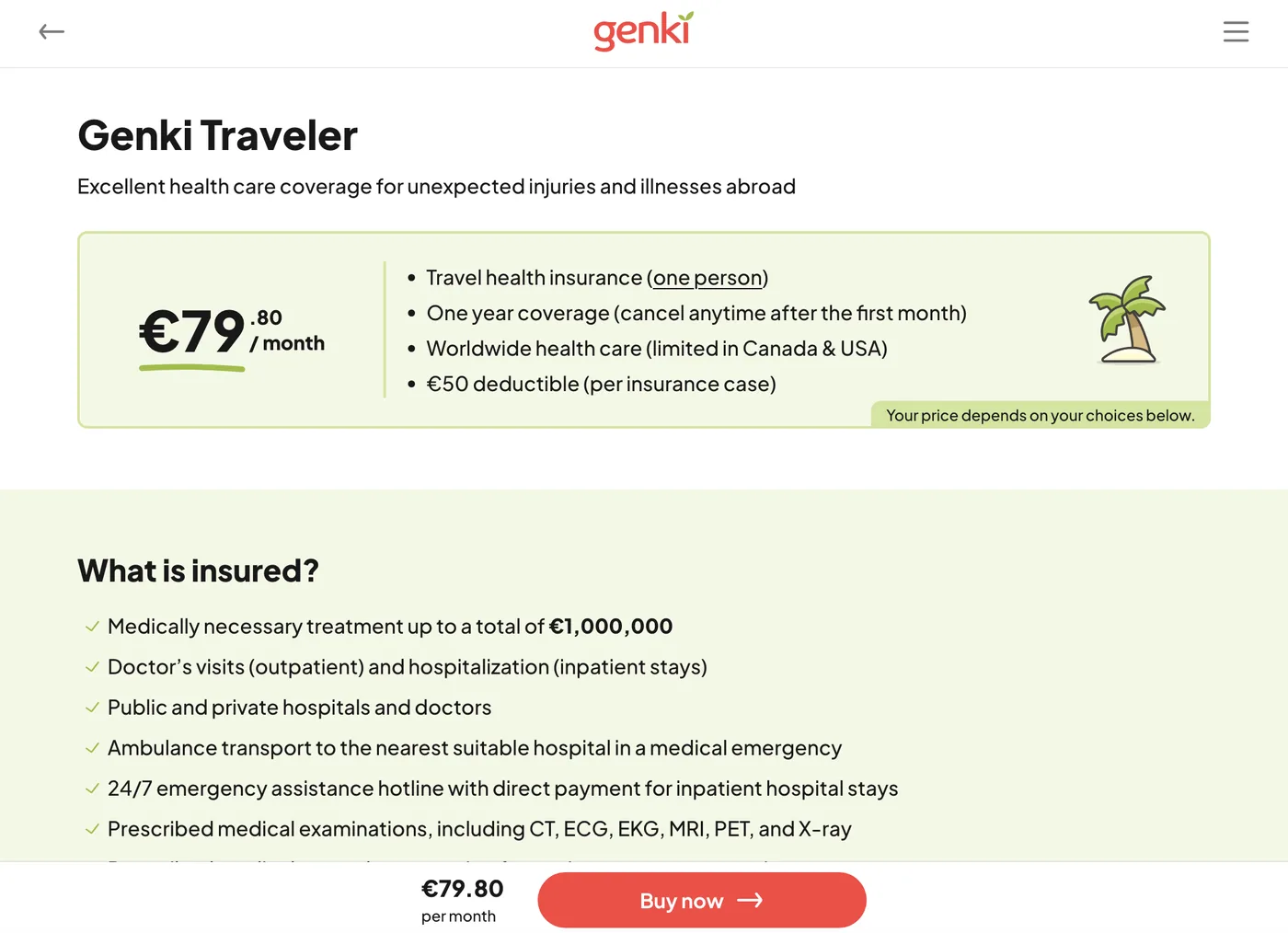
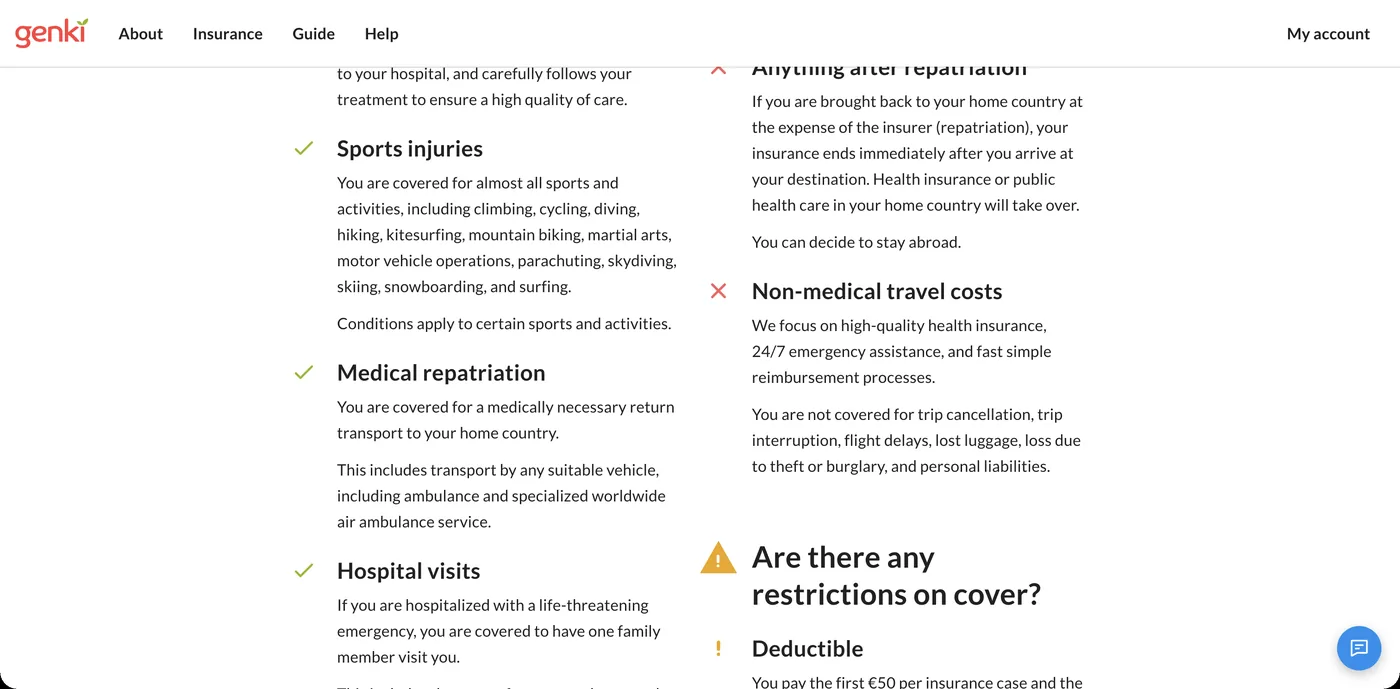
SafetyWing’s Nomad Insurance descends from travel medical cover: emergency treatment abroad plus the extras a per-trip policy would carry, meaning luggage, personal liability, trip interruption and emergency evacuation. Genki Traveler descends from health insurance: a €1,000,000 treatment ceiling, a €50 deductible, a long covered-sports list, and zero interest in your suitcase or your flight schedule. Genki’s own product page lists the exclusions plainly: no cancellation, no luggage, no theft or burglary losses, no liability (September 2026).
I buy insurance per trip, when the itinerary justifies it, and the first thing I read in any policy is what it is for. Our guide to what travel insurance covers breaks down the categories these two products are drawn from.
The numbers, side by side
Prices and policy limits last verified September 2026; both providers’ motorbike clauses, July 2026.
| SafetyWing Essential | Genki Traveler | |
|---|---|---|
| Price, youngest band | $62.72 per 4 weeks (ages 18-39) | No public list price; quoted by age and region |
| Overall medical limit | $250,000 | €1,000,000 |
| Deductible | $250 per coverage period | €50 per case; none for inpatient stays |
| Evacuation / repatriation | $100,000 lifetime | Medically necessary return transport included |
| Luggage | $3,000 per period, $500 per item | Not covered |
| Personal liability | $25,000 | Not covered |
| Trip interruption / delay | Included, with caps | Not covered |
| USA & Canada | Paid add-on: $53.48 per 4 weeks on our Sept 2026 checkout | First 7 days of each stay, emergencies only; paid upgrade for full cover |
| Scooters | Licence for the class + helmet, no racing | No licence needed up to 125cc / 11 kW / 110 km/h, helmet on, no racing |
| Maximum run | Rolling, renews every 4 weeks | Up to 1 year, 1-month minimum |
SafetyWing’s price comes from its public pricing page and its limits from the WorldTrips Description of Coverage, both checked September 2026. Genki publishes no list price at all: the Traveler page routes you straight into a quote that moves with age and region (checked September 2026), so treat any flat monthly figure you find on other sites as somebody’s old screenshot and run your own quote. Mine, run in September 2026 with Spain as the region, came back at €63.90 a month at age 30, €79.80 at 45 and €168.30 at 60. SafetyWing’s four-week cycle means thirteen payments a year; Genki bills by calendar month.
What SafetyWing does that Genki won’t
Everything travel-shaped. The wording behind SafetyWing Essential carries luggage cover at $3,000 per coverage period with a $500 per-item cap, $25,000 of personal liability, trip interruption and travel delay benefits, and $100,000 of lifetime emergency evacuation (WorldTrips Description of Coverage, September 2026). None of that exists on Genki Traveler: lose a bag and you are filing against the airline, nobody else.
The trade sits on the medical side. SafetyWing’s overall maximum is $250,000 with a $250 deductible per coverage period. That is a workable emergency floor across most of Asia, Latin America and Europe, and thin against hospital arithmetic in expensive systems. Our full SafetyWing review reads the rest of the wording.
What Genki does that SafetyWing can’t match
Genki’s pitch is depth. Traveler’s treatment ceiling is €1,000,000, roughly four times SafetyWing’s, and the deductible is €50 per insurance case, waived for inpatient stays (Genki Traveler product page, September 2026). A €50 threshold changes behaviour: a €120 clinic visit is worth claiming on Genki and pointless under SafetyWing’s $250 per-period deductible.
The sports posture is broad too: the covered list names climbing, diving, kitesurfing, martial arts, skiing, surfing and motor vehicle operation, with exclusions saved for the properly silly: BASE jumping, wingsuit flying, running of the bulls. SafetyWing works from a named exclusion list and add-ons instead.
Nothing here protects a bag or a booking, though. What Genki does cover, it covers for up to one year on a one-month minimum. Our full Genki review works through the rest of the product.
The scooter clause, head to head
This is the clause I would check before either buy button. SafetyWing covers motorbike accidents when you are licensed for the vehicle class, wearing a helmet and not racing; its coverage document separately excludes motorised dirt bikes and quads (SafetyWing FAQ and Description of Coverage, July 2026). Genki’s help centre states that Traveler covers light motorcycles up to 125cc, 11 kW or 110 km/h with no licence requirement, helmet mandatory, racing excluded (July 2026).
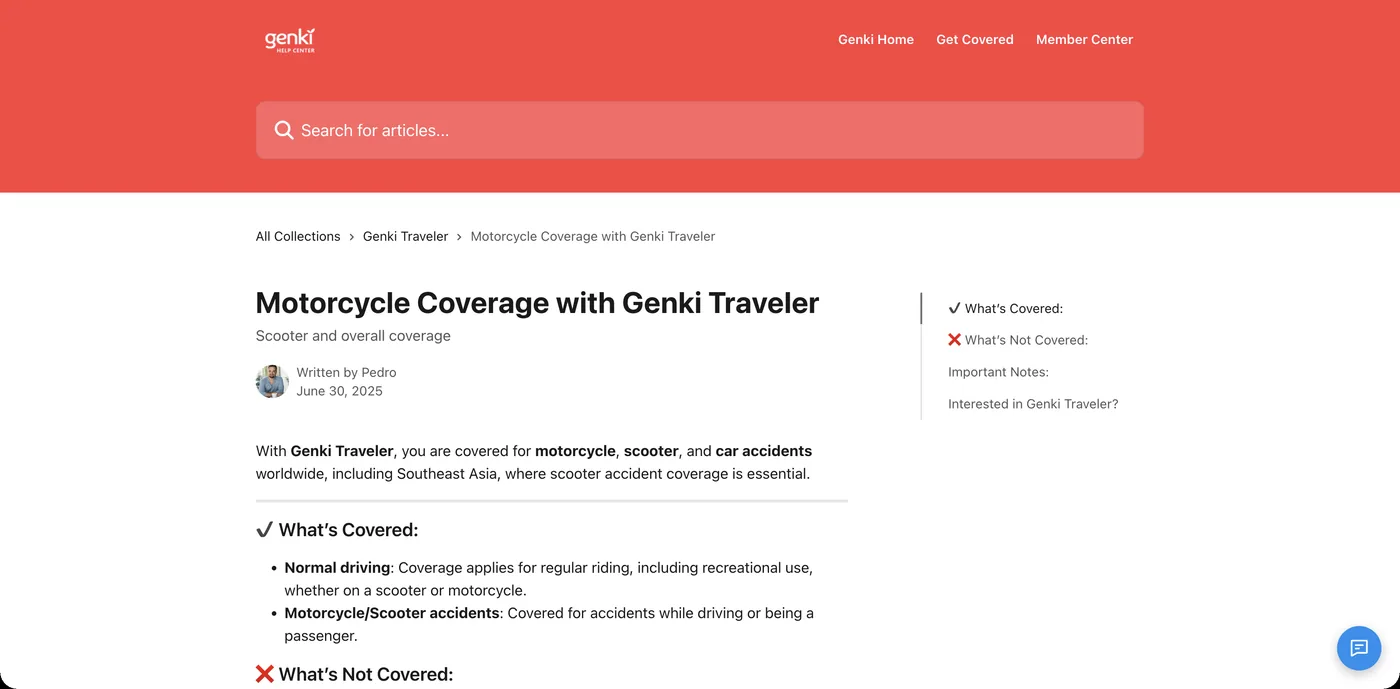
Rental fleets in Chiang Mai, Canggu and the Thai islands run overwhelmingly on scooters in that under-125cc class, and most tourists renting them hold a car licence at best. The UK government’s Thailand travel advice spells out what that usually means: riding without a valid licence can invalidate a travel insurance policy outright. Under SafetyWing’s wording, an unlicensed rider who crashes is an uncovered rider. Under Genki’s terms, the same crash is a covered medical case.
That clause buys medical cover, and nothing more. Riding unlicensed stays illegal: Thailand requires a licence for the vehicle class, and the UK’s Indonesia advice is explicit that a foreign licence alone is no good there, you need an International Driving Permit. And because Genki carries no liability cover, the damage to whatever you hit stays yours as well. Our scooter travel insurance guide goes deeper. The short version: helmets are non-negotiable, required by Thai law and by both insurers, even when the rental shop shrugs.
US coverage on both sides
The United States is where each design shows. SafetyWing sells US cover as a paid add-on on top of the base subscription; the exact surcharge appears in checkout once your dates and age go in. On my September 2026 checkout, 10-39 age band, it was $53.48 per 4 weeks on top of Essential’s $62.72, taking the US-inclusive total to $116.20. The harder question is the ceiling: $250,000 disappears fast in an American ICU, so the add-on buys presence more than depth.
Genki includes the first 7 days of each US or Canada stay for medical emergencies at no extra cost; full US cover is a paid upgrade priced through its quote flow (Genki Traveler product page, September 2026). For short US stopovers, that included week is one of Genki’s best features, and the €1,000,000 ceiling is far better matched to US billing.
Claims texture: what filing feels like
Nobody outside a claims department can benchmark claims handling, so I read reviews as sentiment and nothing stronger. The 2026 pattern on SafetyWing is consistent: documented claims pay, while friction concentrates on ambiguous exclusions and slow peak-season queues. Genki’s long-term write-ups describe reimbursements as straightforward when invoices are complete, and the recurring complaint is scope rather than payment: travellers discover mid-trip that bags were never included. Either way, photograph every invoice and file the same day; Genki’s €50 threshold simply makes more of those photos worth sending.
Verdict: pick by failure mode
Run your own Genki quote before comparing totals, because the published half of this price comparison is SafetyWing’s alone. Then decide which bad day you are buying your way out of.
- Gear, flights and moving parts: SafetyWing, the only one that pays anything for a lost bag, a liability claim or a wrecked connection.
- Long, slow stays with rented scooters: Genki. The no-licence clause up to 125cc plus the €1,000,000 ceiling matches how Southeast Asia is travelled.
- US-heavy plans: Genki’s ceiling and included stopover week fit better; SafetyWing’s add-on works for shorter presence with a thinner limit behind it.
- Routine care: neither base plan covers it; that conversation is SafetyWing Complete or Genki’s Native tier.
SafetyWing
Emergency medical plus luggage, liability and trip benefits in one rolling subscription.
Genki
A €1,000,000 ceiling and a €50 deductible, minus the travel extras.
Whichever you land on, read the wording the night you buy. It is a bad document to meet for the first time in a hospital corridor.
FAQ
Can I start SafetyWing or Genki after my trip has already begun?
Yes, with one catch on Genki’s side. SafetyWing was built around starting while already abroad and renews in four-week cycles until you stop it. Genki Traveler also sells mid-trip, but if you had no other coverage abroad before it starts, only medical emergencies are covered for the first 14 days. On either policy, a condition that first appeared under the old cover counts as pre-existing on the new one, so switch while healthy.
Does either subscription cover routine check-ups or preventive care?
No. SafetyWing Essential and Genki Traveler pay for medically necessary treatment only. If routine care matters, the upgrade paths are SafetyWing Complete at $177.50 a month for ages 18 to 39 (September 2026) or Genki’s Native product, full international health insurance priced by individual quote.
Do I still need separate travel insurance for baggage and cancellations with Genki?
Yes, if you want those risks covered: a per-trip policy for an expensive itinerary, or a credit card whose protections handle cancellation while Genki handles the medical side. SafetyWing bundles modest versions of all of it, which is the plainest argument for choosing it instead.