

Home»Insurance
Travel Insurance: What to Check Before You Buy
By  Ignas Simkus|Last updated: 21 July 2026|How we test
Not lost luggage. Luggage cover is the part people compare, and it’s close to irrelevant. The sums are small and the excess eats much of it. I’m an occasional buyer by design: cover when the itinerary earns it, and a hard read of the exclusions before paying. That lens shapes everything below.
What you’re actually insuring against
The reason to hold travel insurance is medical costs abroad, and specifically the tail risk: an accident or illness serious enough to need hospital treatment, and in the worst case a medically supervised flight home. Emergency repatriation is the expensive item, running well into six figures in some circumstances, and it is the thing that turns a bad trip into a life-altering financial event.
Everything else (delays, cancellations, baggage) is a convenience benefit: nice to have, but not the point.
The questions that decide which policy you need
How long is the trip, and how many trips this year?
Single-trip policies suit one defined holiday. Annual multi-trip policies are usually cheaper from about the third trip a year, but almost always cap the length of each individual trip, commonly around 30 days. Frequent short-haul travellers are usually better off annually; someone taking one long trip is not.
Open-ended or long-stay travel is a different product again, and the monthly subscription policies exist for exactly that case.
Where are you going?
Cost is driven mostly by healthcare prices at the destination. Policies covering the US and Canada cost substantially more than Europe-only ones, because treatment there costs substantially more. If you’re not going, don’t pay for it.
What are you going to do there?
This is where most claims fail. Standard policies exclude a long list of activities: motorcycle and scooter riding, skiing and snowboarding, diving below certain depths, climbing, and much else. Renting a scooter for a day is one of the most common ways travellers discover they’re uninsured, often without a licence category the policy requires.
Read the activities schedule. If your plans appear on the exclusions list, buy the add-on.
What have you already had?
Pre-existing conditions must be declared, and failing to declare is the fastest route to a rejected claim. Declaring may raise the premium; not declaring can void the policy entirely, including for something unrelated. Declare everything, however minor it seems.
Reading a policy in five minutes
Skip the marketing page and open the policy wording itself. Four things:
- The medical limit, and whether repatriation is included within it or capped separately.
- The excess: what you pay per claim. A low premium with a high excess can leave you paying for anything short of a disaster.
-
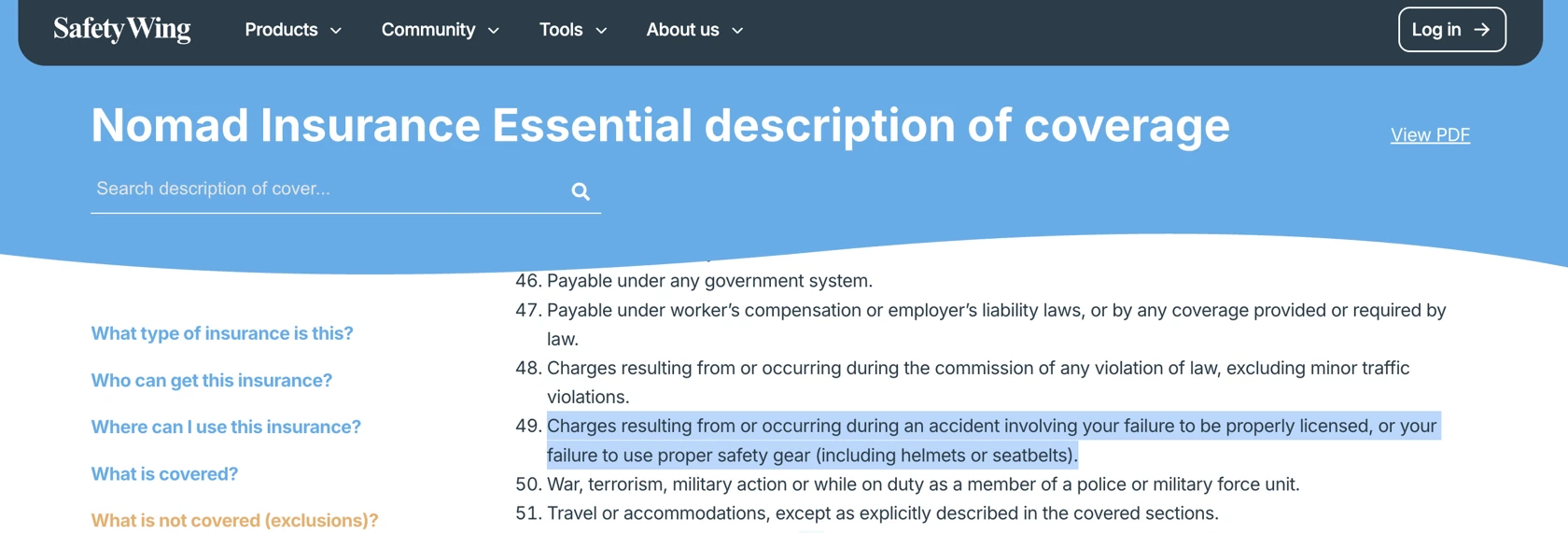
Read the exclusions before the marketing: anything where you weren’t “properly licensed” or wearing “proper safety gear” isn’t covered, the same trap that catches scooter riders. Five minutes in this list is what saves the claim. The exclusions list. The most informative page in the document, and the one nobody reads.
- The claims process: particularly whether they pay providers directly or expect you to pay and reclaim. In a serious situation, that distinction matters enormously.
Also worth knowing: if you hold a European Health Insurance Card (or the UK’s GHIC) and are travelling within Europe, it covers state healthcare on the same terms as a local. It is not a substitute for insurance (it does not cover repatriation or private treatment), but it changes what you need from a policy.
Who we cover
- SafetyWing: monthly subscription cover suited to open-ended and long-stay travel
- Heymondo: per-trip cover with in-app doctor access; the pick for defined trips
- Genki: medical-first long-stay cover, lighter on trip and baggage benefits
Our pick for a normal, dated trip: Heymondo. Per-trip cover with an in-app doctor chat and 24/7 assistance fits the way most people actually travel, and pricing scales with the trip instead of a subscription you forget to cancel. The answer flips to SafetyWing the moment your trip is open-ended, and to Genki when what you really want is long-stay health insurance rather than trip protection. Reasoning on our travel tech stack.
Travel insurance guides
- Best Travel Insurance for Digital Nomads (2026): SafetyWing, Genki and Heymondo compared for digital nomads: subscription vs per-trip cover, real policy…
- Heymondo Review (2026): Per-Trip Cover With Real Ceilings: Heymondo is the per-trip pick with premium limits: up to $10M medical, zero deductible options, and an…
- SafetyWing Review (2026): The Policy Document, Actually Read: SafetyWing’s Nomad Insurance is the default subscription cover for long-term travellers. What the…
- The Scooter Clause: How Travellers Void Their Insurance in One Rental: Most travel insurance excludes scooter accidents unless you hold a real motorcycle license. The clause,…
- What Travel Insurance Actually Covers (and the Fine Print That Decides It): Travel insurance is four products in one envelope: medical, cancellation, belongings, liability. What each…
The rest of the stack
Insurance covers what goes badly wrong. The other three cover the daily friction: an eSIM for data on landing, a VPN for services that misbehave abroad, and a travel card that doesn’t tax every purchase. See our travel tech stack.
A necessary caveat, and we’d rather be blunt about it: we can test an eSIM by using it. We cannot test an insurer without making a claim. So everything we say about these policies comes from reading the policy documents, and we will always tell you which document and when we read it. Anyone presenting insurance rankings as though they’ve road-tested the claims process is telling you a story.
This is general information, not a recommendation on your specific circumstances. Cover needs vary with health, destination, and activities, and the policy wording is always the authority. Our sourcing standards are in how we test.