


Best Travel eSIM in 2026: Ranked for Real Trips
By  Ignas Simkus|Last updated: 22 July 2026|How we test
There is no single best travel eSIM, and any page that claims otherwise is guessing. I learned this the expensive way, via a “tourist internet package” that barely worked once I’d paid for it; the network check this guide is built on is what that burn turned into. The right pick changes by destination, because each provider resells a different local network. Here is how the main players actually differ, and which one fits which kind of trip.
Article Summary
- Safest all-rounder: Airalo, for the widest country catalogue
- Best for heavy users: Holafly, for unlimited plans (mind the daily fair-use cap)
- Best value per GB: Nomad, frequently the cheapest for larger data packs
- Best app and support: Saily, newer, clean, with a built-in security layer
The one thing that decides it: the underlying network
An eSIM provider does not own mobile masts. It buys wholesale access to a local carrier and resells it to you. So “Airalo in Japan” really means “a Japanese network, resold by Airalo”. If that underlying network is weak where you are going, no amount of app polish will fix your signal.
This is why the honest answer to “which eSIM is best” is “best where?” A provider that is excellent in Europe can be mediocre in Bali if it resells the wrong local network. The good providers name the carrier on the plan page. Our country guides, like Japan, judge by network first and app second.
The providers we cover
Airalo
The category default: 200+ countries and regions, over 30 million users, and since 2026 it sells unlimited plans in select destinations alongside its fixed packs. Rarely the very cheapest, but almost always available and predictable. Read our Airalo review.
Saily
Built by the team behind NordVPN, with a clean app and a built-in ad and tracker blocker. A strong pick if you want the connectivity and a light security layer in one. Read our Saily review.
Holafly
The unlimited-data specialist, for people who refuse to count megabytes. One thing the marketing understates: per 2026 reporting the plans run full speed for roughly 3 to 5 GB a day depending on destination, then throttle until the daily reset, and the threshold is not published on plan pages. Plenty for most, but worth knowing.
Nomad
Frequently the cheapest for larger data packs, and strong across Asia. The value pick when you want a chunk of data without paying the brand premium.
How to choose, quickly
| Your trip | Start here | Why |
|---|---|---|
| Short trip, one country | Airalo or Nomad | A small local plan; skip regional plans you will not use |
| Multi-country trip | Airalo regional | One plan across borders, no re-buying at each |
| Heavy user / no data anxiety | Holafly | Unlimited, after you have read the daily cap |
| Want light security too | Saily | Data plus built-in ad and tracker blocking |
| Tightest budget | Nomad | Usually the lowest price per GB on bigger packs |
What the plans actually cost
| Provider | Entry point | The value shape |
|---|---|---|
| Airalo | ~$4.50 for a 1 GB starter | Predictable mid-market; regional bundles are its edge |
| Saily | Country plans from $1.99; global from $8.99 | Sharp on popular routes; perks stack on top |
| Holafly | ~$6-7 per day, unlimited | Flat-rate freedom; cheaper per day on long trips |
| Nomad | Best routes near $0.5-0.7 per GB on big packs | The per-GB floor of the mainstream field |
Prices and policy terms last verified July 2026.
Prices move constantly, so treat these as the shape of the market rather than a quote; the plan page is always the final word. The pattern that persists: Saily and Nomad fight for the value crown, Airalo charges a modest premium for breadth and predictability, and Holafly charges for the right to stop thinking.
Start with the destination, not the brand
Because the resold network decides everything, the sharpest version of this guide is the per-country one, and those now exist for the routes people actually fly. Japan is a carrier-coverage story; Thailand comes down to AIS versus True; Bali is a one-question decision about Telkomsel; Vietnam hinges on Viettel’s rural reach; Europe is the one place regional multi-country plans genuinely win; and the USA splits by whether you are staying in cities or driving between them.
If your destination is not on that list yet, the generic rule carries you: open the plan page, find the resold network, check its coverage map for the regions you will actually visit. Sixty seconds, better than any brand loyalty.
How much data do you actually need?
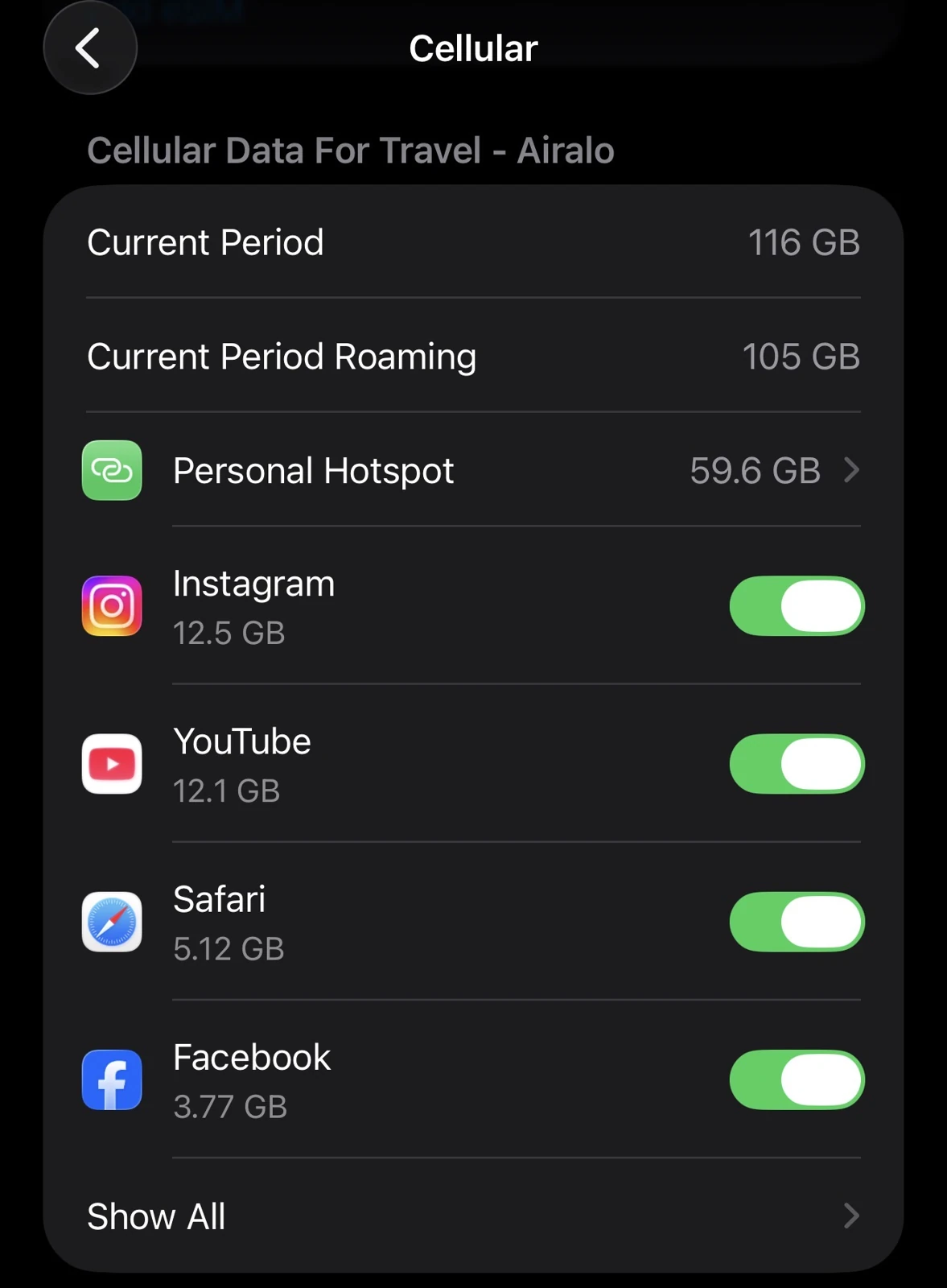
Most travellers overbuy. Maps and messaging sip data; video and photo uploads gulp it. Streaming standard-definition video runs about 700 MB an hour, while turn-by-turn maps use closer to 5 to 10 MB. On a two-week trip, a light user typically gets by on 3 to 5 GB, a moderate user on 5 to 10 GB, and a heavy streamer or hotspot user on 12 to 20 GB. Download offline maps before you go and the light number drops further still. For calibration from the far end of the scale: my own counter after a month of full remote work abroad read 105 GB of roaming, but nearly 60 GB of that was laptop hotspot and another 25 GB was Instagram and YouTube. Strip the laptop and the doomscrolling out and even my phone-only footprint lands inside these bands.
Quick answers
Can I call and text with these? They are data-only by default: your apps (WhatsApp, FaceTime, Telegram) handle calls over data, and your home number stays live for SMS in the dual-SIM setup our install guide describes. Exceptions exist: Saily sells optional voice packs and a US number, and some resold local tourist eSIMs include a local number.
Do travel eSIMs work on cruise ships and ferries? No. At sea you are on maritime satellite networks that these plans exclude; airplane mode on the crossing prevents surprise charges.
What happens to leftover data? It expires with the plan’s validity window. Unused gigabytes are the cheap insurance you hope to waste; an expired plan with a fat balance still beats an emergency top-up bought at roaming prices.
Can I delete the eSIM after the trip? Yes, once you are sure it is over. Never mid-trip: on most providers, Airalo included, a deleted profile cannot be reinstalled and the purchase is gone.
A note on how we rank
We do not sell placement, and commission never sets the order. Prices and fair-use policies move often, so we re-check every figure against the provider before it goes in, and the plan page is always the final word on what you will pay today. Our full standard is in how we test, and the incentives behind these links are in our affiliate disclosure. For a live demonstration of why the resold network outranks the brand, see the Mexico guide, where the category default currently rides the weakest map.
Comparing two specific providers? Start with Airalo vs Holafly, the fixed-data versus unlimited decision most people are actually weighing.
FAQ
Is a travel eSIM cheaper than roaming?
Against classic per-megabyte roaming, dramatically so; destination eSIM data routinely costs a tenth of big-carrier roaming rates. The one exception is flat daily-fee roaming passes, which can break even on a two-day hop. Past a few days, the eSIM wins every time.
Do travel eSIMs come with a phone number?
Most are data-only, and for travel that is fine: WhatsApp, iMessage and your bank’s texts keep working because the home SIM stays active alongside. A few providers sell number add-ons if you genuinely need local calls.
Can I top up a travel eSIM mid-trip?
The good providers make it a two-tap job in the app, no new QR, no reinstall. It is one of the quiet criteria in this ranking: products that treat top-ups as routine are the ones that save you an airport meltdown later.