


Surfshark for Travel (2026): The Family-Trip VPN
By  Ignas Simkus|Last updated: 3 September 2026|How we test
Surfshark’s headline feature is a number: unlimited. One subscription covers every phone, laptop and tablet your travelling party owns, which changes the math completely for families and groups, the connected-devices shot below is my own Mac and iPhone on one login. The rest of the product is stronger than its price implies, with two caveats worth knowing.
Article Summary
- Best for: families and multi-device travellers: unlimited simultaneous connections
- Strongest at: value, device count, aggressive intro pricing
- Watch for: renewal jump, and speeds a step behind Nord on long routes
- Jurisdiction: Netherlands; audited by Deloitte
The unlimited-devices math
Most VPNs cap simultaneous connections at 5 to 10. Surfshark removes the cap: one subscription, every device, no exceptions. A family of four travels with eight to twelve connected devices between phones, laptops, tablets and a Kindle someone insists on. On a capped plan that means choosing who is protected tonight; on Surfshark it means everything, always, including the kids’ devices on the resort wifi. For group travel this single term beats every other spec on the sheet, and it is why the travel VPN ranking hands Surfshark the family slot without much argument.
The rest of the product
The network runs 4,500+ servers across 100 countries: roughly half of NordVPN’s fleet and two-thirds of its country list, which in travel terms means the nearest fast exit is occasionally one country further away. Speed is good rather than category-leading: WireGuard-based and comfortably fast in our own testing, with speed loss close to Nord’s, figure a few points more on the longest international routes. For a hotel-wifi connection that tops out at 50 Mbps anyway, the difference is theoretical; for hotel gigabit in Seoul, it is measurable.
The travel-relevant feature set covers the essentials: Camouflage mode obfuscates traffic for networks that dislike VPNs, CleanWeb blocks ads and trackers at the tunnel level, and the kill switch behaves properly through reconnects. Streaming access matched Nord in our own runs: every major platform we tested came unblocked.
On trust: a Deloitte no-logs audit and regular app audits, Netherlands jurisdiction, and one disclosure that belongs in every honest review: Surfshark and NordVPN have shared a parent company since their 2022 merger under Nord Security. They operate as separate products with separate infrastructure, and the practical takeaway is simply that the two “rivals” at the top of most rankings, ours included, are siblings.
Two smaller features earn a travel mention. Alternative ID generates a disposable email identity for the wifi portals and booking sites that demand an address they do not deserve, which is a neat fit for the amount of email-harvesting travel involves. And the rotating-IP option changes your apparent address periodically without dropping the tunnel, useful for staying under the radar of the rate-limiting some booking engines apply to repeat searchers.
The honest drawbacks
Works well
- Unlimited devices: the family-trip clincher
- Strong intro pricing, frequent long-term deals
- Full obfuscation + ad-blocking feature set
- Audited no-logs policy
Trade-offs
- Renewal jumps sharply from the $2.49/month 2-year intro, the category disease; the 30-day money-back guarantee is the risk-free test window
- A step behind Nord on long-route speed
- Netherlands jurisdiction sits inside EU data frameworks; purists prefer Proton’s Switzerland
Prices and policy terms last verified July 2026.
Setting it up for a travelling household
The unlimited-device promise only pays off if the setup actually happens, so here is the twenty-minute version, done at home the week before the trip. Install the app on every device that is coming: each phone, laptop and tablet, plus the streaming stick if one travels with you. Log them all into the one account; there is no per-device registration to manage, which is half the reason this works for families. On each device, turn on auto-connect for untrusted wifi, so the resort network is tunnelled without anyone remembering to do anything, and leave CleanWeb on, which quietly removes a layer of ad sludge from every screen the kids look at.
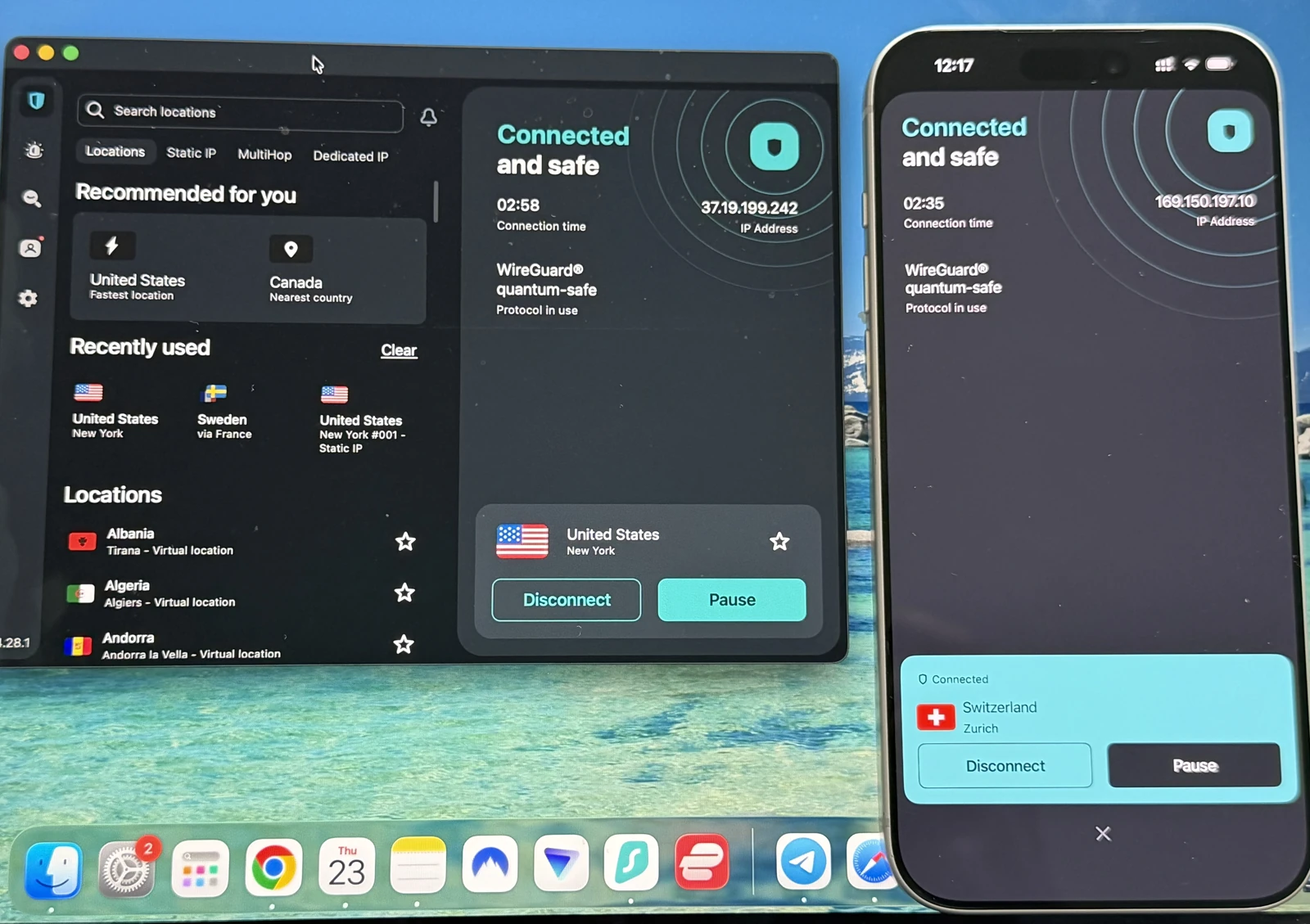
Two settings deserve a decision rather than a default. The kill switch: on for the adults’ devices, where a dropped tunnel mid-banking matters; optional for a child’s tablet, where a blocked connection generates more support tickets than it prevents harm. And server choice: pin everyone to the same nearby city, because two devices on one hotel wifi exiting through different countries is how streaming apps get confused and someone’s game store locks itself for review.
The payoff, concretely: on a two-week family trip, every device on every airport, hotel and rental wifi rides the tunnel, the banking-app problems are pre-solved from home, and nobody had to decide whose laptop deserved protection tonight. That is what the unlimited term buys, and no capped rival matches it at any price.
Verdict
Travelling solo with one phone and one laptop, NordVPN’s speed and streaming record justify its price; that case is made in the NordVPN review and the direct head-to-head. Travelling as a household, Surfshark’s unlimited devices flip the answer: covering everything for one fee is worth more than a speed delta you will rarely notice on hotel wifi. Buy on the intro deal, diarise the renewal, and enjoy being the family’s least stressed IT department.
FAQ
Can I share Surfshark with my family?
Yes, and it is the product’s whole pitch: one subscription covers unlimited devices, so the family’s phones, laptops and tablets all ride the same account, including while people are in different countries. Just share the login sensibly; simultaneous connections are genuinely uncapped.
Is Surfshark’s unlimited devices actually unlimited?
Genuinely, yes: one subscription, every gadget you and the family carry. It is the single feature that decides Surfshark for group travel, and nothing else in the category matches it.
Does Surfshark slow connections more than rivals?
Same protocol generation, same physics: nearby servers cost little, far ones more. Based on our hands-on experience connections were stable; the real differences against rivals show up in server pickiness, not headline speed.
What is CleanWeb and do I need it?
A tracker and ad filter at the VPN level. Abroad it moonlights as a data saver, since fewer ads means fewer megabytes on a metered eSIM. Not a reason to buy, a nice thing to switch on.