


Proton VPN for Travel (2026): The Privacy-First Pick
By  Ignas Simkus|Last updated: 22 July 2026|How we test
Proton VPN is what you pick when the jurisdiction section of a review is the part you read twice. Swiss, open source, funded by subscriptions rather than data, and carrying, tested on my own account, the only genuinely usable free tier in the industry worth recommending. The travel case has real strengths and one honest weakness.
Article Summary
- Best for: privacy-first travellers, journalists, anyone who wants a credible free tier
- Strongest at: trust architecture: Swiss law, open-source apps, annual audits
- Watch for: slower long-route speeds than Nord; streaming needs the paid tier
- Free tier: real, no data cap, a handful of countries, no streaming
The trust architecture, which is the product
Proton’s pitch is structural rather than promotional. Jurisdiction: Switzerland, outside EU data-retention frameworks and the major intelligence-sharing alliances, with a legal system that requires a Swiss court order to compel anything. Transparency: the apps are open source, with independent no-logs audits by Securitum (most recently August 2025) and reports published rather than summarised in a press release. Funding: the company behind Proton Mail, financed by subscriptions, with a track record of fighting legal requests and publishing the outcomes. No provider deserves blind trust, and our default posture toward no-logs marketing is skepticism, but Proton’s verification stack is the deepest in the consumer market.
What that buys a traveller
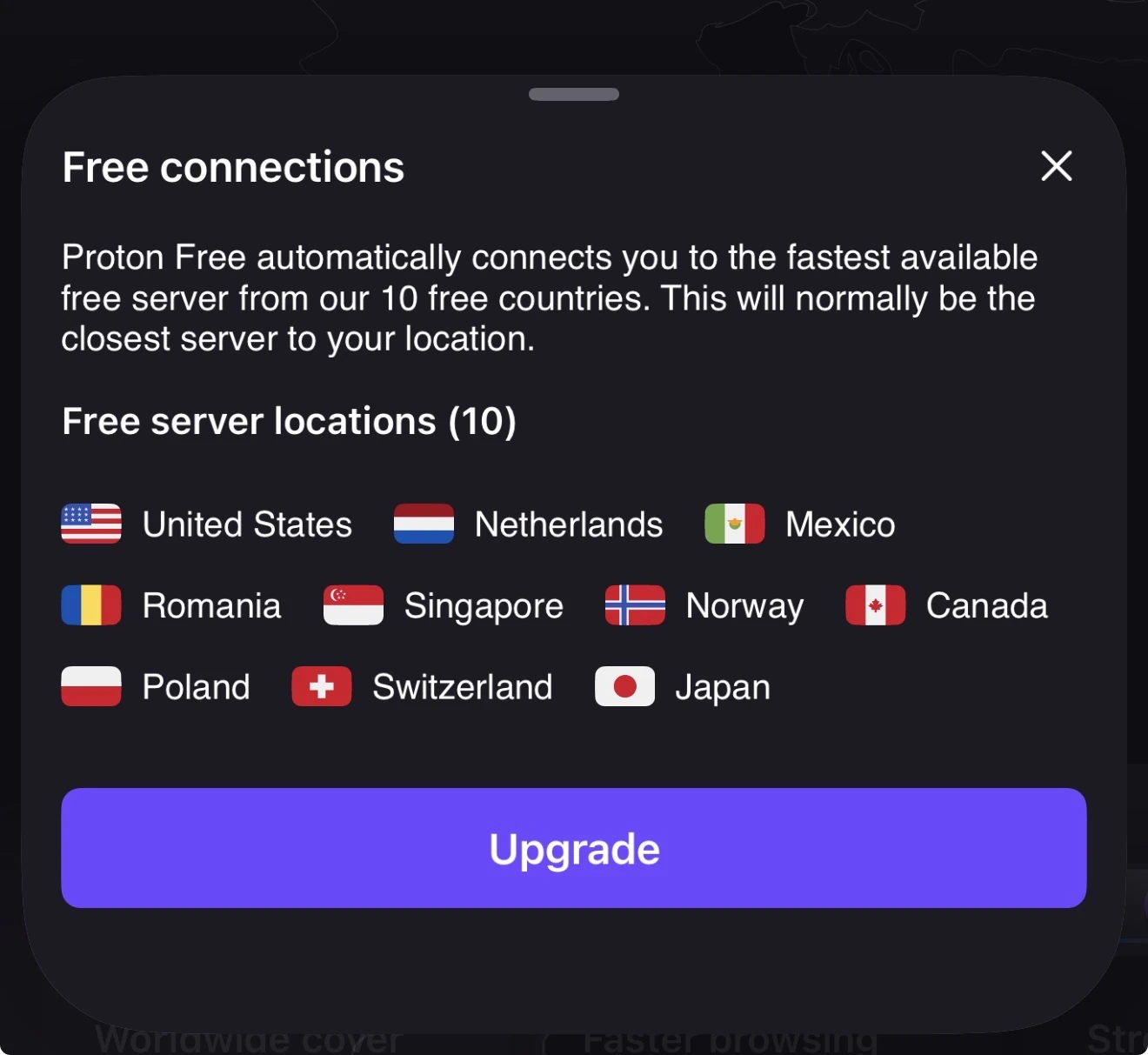
The free tier that is actually usable. The exact shape, because the details are the product: one device at a time, no data cap, no ads, no speed throttling by policy, servers in around ten countries. What it excludes is equally specific: no streaming-optimised servers, no P2P, no Secure Core routing, no NetShield ad-blocking. As a backstop VPN, something on the laptop for airport wifi on a trip where you did not plan to need one, it is the only free product we will name without a warning attached, because the business model does not require selling you.
Secure Core for the paranoid ceiling. Paid plans route traffic through hardened Swiss, Icelandic or Swedish data centres before exiting elsewhere, defending against compromised exit servers. Overkill for tourists; exactly the point for journalists and researchers working somewhere hostile.
Stealth for restrictive networks. Proton’s obfuscation protocol gives it a seat at the restrictive-country table, with a thinner but real track record beside Nord’s in our China guide.
The honest weakness
Speed at distance. Our own testing puts Proton third of our three picks for speed, behind Nord and Surfshark, and the free tier is slower still. Its server network, 110-plus countries but thinner per-country density, means the nearest fast exit is sometimes not that near; if speed is the priority, Nord is the pick. Streaming on the paid tier is better than its reputation: in our own test it unblocked on all four servers we tried, and 2026 lab testing credits it with 90-plus services. The free tier is the wrong tool here; it failed every streaming attempt we made, exactly as Proton says it will. For a traveller whose VPN is mostly for home-catalogue streaming and raw speed, that makes Proton the close second choice; for one whose VPN is about not being surveilled, the ordering flips.
Works well
- Deepest trust stack in the market: Swiss, open source, audited
- The one recommendable free tier
- Secure Core and Stealth for genuinely hostile environments
- No renewal-price ambush: pricing is stable and published
Trade-offs
- Slower than Nord on the long routes travel creates
- Streaming needs the paid tier and varies more day to day
- Apps are cleaner than they were, still less polished than the big two
Prices and policy terms last verified July 2026.
Using the free tier well
The free tier deserves its own instructions, because it is most useful installed before you need it. Put it on the laptop and the phone at home, log in once, and it becomes the zero-cost floor under every sketchy network the trip produces: the airport wifi that demands a survey, the cafe network named after a cafe two doors down, the Airbnb router of unknown vintage. No data cap means a full evening of browsing rides it without drama; medium speeds mean it is not the tool for pulling a season of anything.
Know its edges so they do not surprise you: one device at a time, so the phone disconnects when the laptop connects; server choice limited to a handful of countries, so the exit is wherever Proton puts you rather than your home country, which means it does not solve foreign-IP banking blocks or home-catalogue streaming. Those two jobs are precisely what the paid tier’s country list exists for, and they are the usual reason a free-tier user eventually upgrades mid-trip, which Proton cheerfully allows from inside the app.
One more free-tier virtue worth naming: it is the right answer to lend. A travel partner who refuses to pay for a VPN but keeps doing hotel-wifi banking is safer on Proton’s free tier than on nothing, and pointing them at it costs you one sentence. The hotel wifi threat model is the sentence.
Verdict
Proton VPN is the right pick for two travellers: the one whose threat model is real, and the one who wants an honest free backstop without a catch. For the mainstream fast-and-streams brief, NordVPN remains the default and Surfshark the family value play; the three-way decision is laid out in the travel VPN ranking. What Proton uniquely offers is the ability to stop wondering about the provider itself, and for a tool whose entire job is trust, that is not a small thing.
FAQ
Is Proton VPN’s free tier good enough for travel?
It is the only honest free VPN: no data cap, no ads, but servers in about ten countries, so speed to distant regions suffers. As a security layer on hotel wifi it is genuinely fine. For streaming, no.
Why is Proton VPN considered the privacy pick?
Swiss jurisdiction, open-source apps, independently audited no-logs (Securitum among the auditors), and a model where paid tiers fund the free one instead of ads. When privacy is the actual point, this is the shortlist of one.
Does Proton VPN unblock streaming?
On paid plans, yes, with the usual server roulette. The free tier deliberately does not; that is the line between Proton’s security mission and its commercial product.