


Best eSIM for Japan (2026): Carrier Coverage Decides It
By  Ignas Simkus|Last updated: 22 July 2026|How we test
Japan has excellent mobile networks, so the question is not whether your eSIM will work, but which underlying carrier it rides on. Get that right and you have flawless data from Shibuya to a rural ryokan; get the payments layer right too, which we cover from our own wallet tests. Here is how the main providers line up, judged by network first.
Article Summary
- Best network: providers on Docomo or SoftBank give the most consistent coverage
- Best value for a typical trip: a 10 to 20GB fixed plan usually beats unlimited on price
- Don’t overbuy: most one to two week visitors need less data than they think
- Check before buying: which carrier the specific plan resells
Why the carrier matters more than the brand in Japan
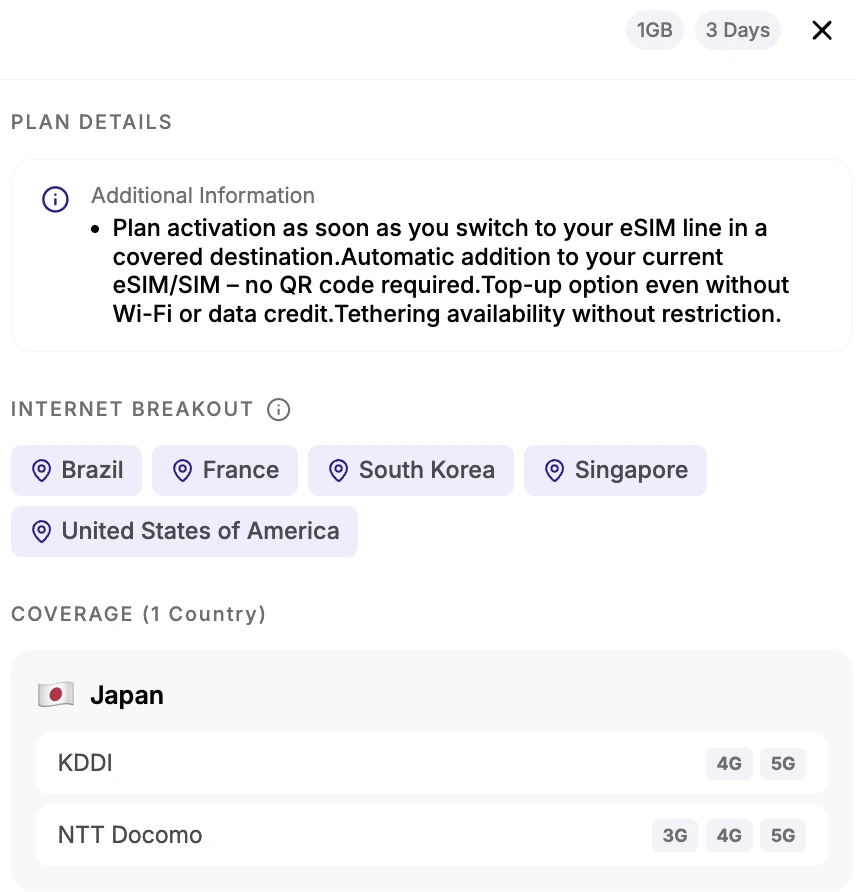
Japan runs three excellent national networks: NTT Docomo, with the broadest reach into rural areas and along the shinkansen lines; SoftBank, strong across cities and the main travel corridors; and KDDI, better known by its au brand. All three are fast. The differences only really show up on the fast trains and in the mountains, and that is exactly where a provider riding Docomo keeps working while a weaker option drops out.
So the useful way to shop is to look past the eSIM brand to the network underneath. This is the core idea behind our whole eSIM approach: you are really buying a Japanese network, resold.
The providers, by network
| Provider | Rides on | Best for |
|---|---|---|
| Ubigi | NTT Docomo, with 5G | Best overall network reach; 5G on the top plans |
| Airalo | KDDI and SoftBank | Best price-per-GB on 10 to 20 GB plans for a typical trip |
| Saily | A major Japanese network | Clean app plus a built-in security layer |
| Holafly | A major Japanese network | Unlimited data, after the daily cap |
Our picks for a Japan trip
Ubigi
Rides Docomo, Japan’s most extensive network, with 5G on its top plans and pricing from around $2.15 per GB. The pick when flawless signal on the shinkansen and in rural stops matters most.
Airalo
For a one to two week Tokyo, Kyoto and Osaka trip (the same maths covers an Osaka-only city break), a 10 to 20GB fixed plan is usually the best price per GB. The safe, well-supported default.
Saily
A clean app with a built-in ad and tracker blocker, from the NordVPN team. A tidy pick if you want light security alongside your data.
How much data for Japan?
Japan is wifi-rich (hotels, convenience stores, many stations), so you may lean on mobile data less than you expect. For a typical one to two week trip with maps, translation apps, messaging and some social media, most visitors are comfortable on 10 to 20GB. Heavy video or hotspot users should size up or consider an unlimited plan, after reading its daily cap.
What speeds to expect
Japan has some of the fastest mobile networks in the world, and this is one country where you will not be fighting for signal in the places tourists go. On a 5G-capable eSIM in Tokyo, Osaka or Kyoto, downloads are quick enough for video calls, streaming and hotspotting without a second thought, and even 4G on Docomo or SoftBank is comfortably ahead of what most travellers get at home. The one place to be deliberate is deep rural travel and the mountains, where Docomo’s wider footprint (and so Ubigi) holds up best. Based on our hands-on experience connections are reliably stable across the majors; speed is genuinely not the deciding factor here, carrier reach is.
Before you go
Install and activate the eSIM at home so you land connected. Confirm your phone is eSIM-capable and unlocked. And if it will not connect on arrival, the fixes are in our troubleshooting checklist.
An eSIM is one part of a Japan trip. The rest of the stack, the cash-and-IC-card payment culture, the wifi myth, streaming and banking from abroad, and the insurance notes, is assembled in our Japan travel tech guide. For the category-wide rankings this pick sits inside, see best travel eSIM, and the standard behind these picks in how we test.
FAQ
Do eSIMs work on the Shinkansen and Tokyo Metro?
Yes. Japan’s networks cover trains and most metro tunnels properly; brief drops between cars and in deep sections are normal physics, not a plan problem. Keep offline maps for arrival day and you will not notice.
Do I need mobile data for Suica and transit cards?
The tap itself works offline, but in-app top-ups and route planning want data, which is one of the quiet reasons day-one connectivity matters more in Japan than most places.
Is free wifi in Japan good enough to skip an eSIM?
That reputation is a decade stale: free wifi exists at stations and convenience stores, gated behind sign-up portals, and disappears exactly where you need directions. Data in Japan is cheap; friction is not.