


Airalo vs Saily (2026): The Default vs the Challenger
By  Ignas Simkus|Last updated: 22 July 2026|How we test
Airalo is the eSIM most people buy first. Saily is the one built by the NordVPN team to take that crown. Both live on my phone, and the side-by-side screenshots below are from my own devices. They sell the same basic thing, prepaid travel data, and differ in exactly three places that matter: catalogue size, app quality, and what happens beyond the data itself.
Article Summary
- Pick Airalo for maximum destination coverage and the safe default
- Pick Saily for the cleaner app, competitive pricing, and the built-in security layer
- Either way: check which local network each resells in your destination first
What they have in common
Both sell prepaid, data-only travel eSIMs: you buy a plan for a country or region, install before you fly, and your phone rides a resold local network when you land. Neither gives you a local phone number by default. Both install from their own apps without QR juggling, both support top-ups mid-trip, and both run support around the clock. For a one-week city trip in a major destination, either will do the job without drama.
The differences start when you look past the basic transaction.
Coverage: Airalo’s home turf
On paper the catalogues have converged: both now claim 200+ destinations. The difference lives below the headline number. Airalo’s regional and global bundles are the most mature in the category, its long-validity plans go further, and its Discover+ tier adds global voice and SMS, which is why obscure destinations and complex multi-country itineraries still default to it.
Saily’s 200+ count is real but its regional options are thinner and its per-country network deals newer. For mainstream destinations, Japan, Thailand, the EU, the US, both are present and competitive. For a multi-stop trip through less-travelled countries, check both catalogues before assuming; depth, not breadth, is where Airalo still wins.
The app and the extras: Saily’s pitch
Saily comes from the team behind NordVPN, and it shows in the software. The app is cleaner than Airalo’s, plan setup is slightly more foolproof, and it bundles a security layer no other mainstream travel eSIM has: ad and tracker blocking plus web protection that screens malicious sites at the eSIM level, with a virtual-location option on some plans. If you were going to run a VPN on hotel wifi anyway, and our travel VPN guides argue you should think about it, getting a light version of that protection inside the data plan is a real convenience rather than a gimmick.
Saily’s 2026 feature run deserves its own paragraph, because none of it existed when most comparisons were written: an optional US phone number, a monthly rolling global plan for frequent flyers, in-app voice packs from $1.99, free access to WhatsApp, Google Maps, Uber and Grab even after your data runs out, and airport lounge access during eligible flight delays. That post-data app access is quietly the best safety net in the category: running out of data with maps and messaging still alive changes the failure mode entirely.
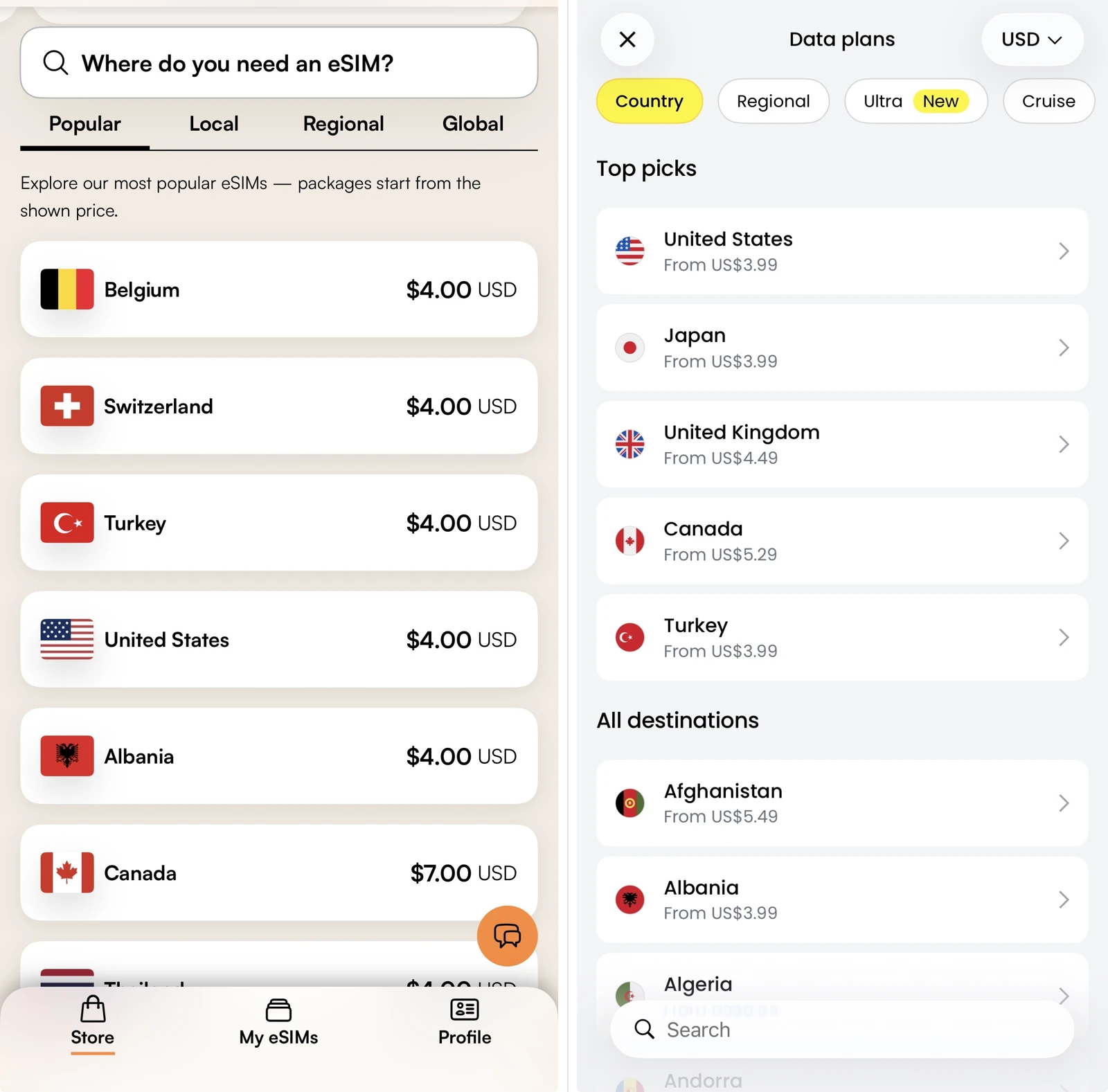
On price, entry points tell the story: Saily’s country plans start at $1.99 against Airalo’s ~$4.50, and Saily is frequently a touch cheaper on popular routes; Airalo claws it back elsewhere. Neither is the budget option: that is Nomad, as our travel eSIM rankings cover.
Head to head
| Airalo | Saily | |
|---|---|---|
| Coverage | 200+ countries; deepest regional bundles | 200+ destinations; thinner regional |
| Entry price | From ~$4.50 | From $1.99 |
| App | Fine, occasionally cluttered | Cleaner, newer, faster to first plan |
| Extras | Top-ups, loyalty credit, Discover+ voice/SMS | Ad/tracker blocking, US number, voice packs, post-data app access |
| Track record | Category veteran, 30M+ users | Newer, backed by Nord Security |
Three trips, decided
Two weeks in Japan. Check both plan pages for the resold carrier first, because Japan is a coverage-decides-it destination, as our Japan guide lays out. Between equal networks, Saily’s pricing on the route has been the sharper one; between unequal networks, the better carrier wins regardless of which app it lives in.
A five-country Europe rail loop. Airalo, mostly on the maturity of its regional Europe bundles: broader country lists and longer product history, which is what you want when the plan has to survive five border handovers. Saily’s Europe options are credible and closing the gap, but the default earns this one.
A working month in one city. Saily, on quality-of-life grounds: the cleaner app matters more across thirty days of top-ups and plan checks, and the built-in tracker blocking earns its keep across a month of cafe wifi sessions. If the month involves serious laptop tethering, check both providers’ hotspot terms before deciding; data-only plan terms vary by destination on both.
The pattern behind all three: destination coverage picks the shortlist, then app quality and price break the tie. Brand loyalty appears nowhere in that sequence, which is the point.
The verdict
Going somewhere unusual, or stacking a multi-country itinerary? Airalo, because the plan you need is more likely to exist, and its regional bundles are more mature. Read the full case in our Airalo review.
Going somewhere mainstream and want the nicest experience per dollar? Saily, especially if the security layer replaces something you would otherwise pay for separately. The Saily review digs into what the Nord pedigree does and does not get you.
And for either: before buying, check which local network the plan resells in your destination and cross-reference the carrier’s coverage map. That single check matters more than the brand, which is the running theme of every destination guide we write, Japan included.
Airalo
The category default. If your destination has an eSIM plan anywhere, it has one here.
Saily
Cleaner software, competitive prices, and a built-in ad and tracker blocker.
FAQ
Is Saily just NordVPN’s version of Airalo?
Structurally yes, both resell wholesale data through an app, but the personalities differ: Airalo brings the largest catalogue and years of coverage mileage; Saily brings app polish, credits, and security extras. The gap narrows every quarter.
Which has better customer support?
Both run 24/7 chat, and both answered our test questions in under ten minutes. Saily’s operation inherits Nord’s support machine; Airalo’s has more eSIM-specific scar tissue. Neither leaves you stranded at 1am, which is the bar that matters.
Which is cheaper, Airalo or Saily?
Neither, permanently. They leapfrog by destination and promo cycle, so check both grids for your actual country and pack size. The winner changes more often than any review can chase.