


Nomad Review (2026): The Value Pick, Checked
By  Ignas Simkus|Last updated: 22 July 2026|How we test
Nomad’s whole argument is the price tag: on larger data packs it routinely undercuts every big name in the category. This review, written with the app installed and its support probed like every provider we cover, is about what you give up for that discount, and the honest answer is: less than you would expect, if you buy it for the right destinations.
Article Summary
- Best for: price-conscious travellers buying 10 GB or more
- Strongest in: Asia, where its network deals are best
- Watch for: plainer app, thinner catalogue than Airalo, coverage varies by destination
- Verdict: the value pick when your destination is one of its strong ones
The price argument
Nomad competes on cost per gigabyte and mostly wins. Its best routes price near $0.5-0.7 per GB on big packs (Italy and Turkey listings run around EUR 0.54-0.61/GB), and its large Thailand bundles, 50 GB for around $12, sit at prices the premium brands do not attempt. Coverage spans 200+ destinations with fixed packs from 1 GB up to 50-90 GB in strong markets, plus unlimited plans in select destinations that run 2 GB per day at high speed before slowing.
Two structural reasons, not charity: Nomad runs frequent destination-specific promotions, and its network deals are aggressive, riding tier-1 partners including AT&T, Vodafone and Singtel in its strong markets. Users rate the result well: roughly 4.3 on Trustpilot and 4.8 on the App Store as of early 2026. That aggressiveness cuts both ways, which is the next section.
What the discount costs you
The app is functional rather than polished: buying, installing and topping up all work, but plan management is plainer than Airalo’s and much plainer than Saily’s. Support is responsive but not the category’s best. None of that affects the data itself.
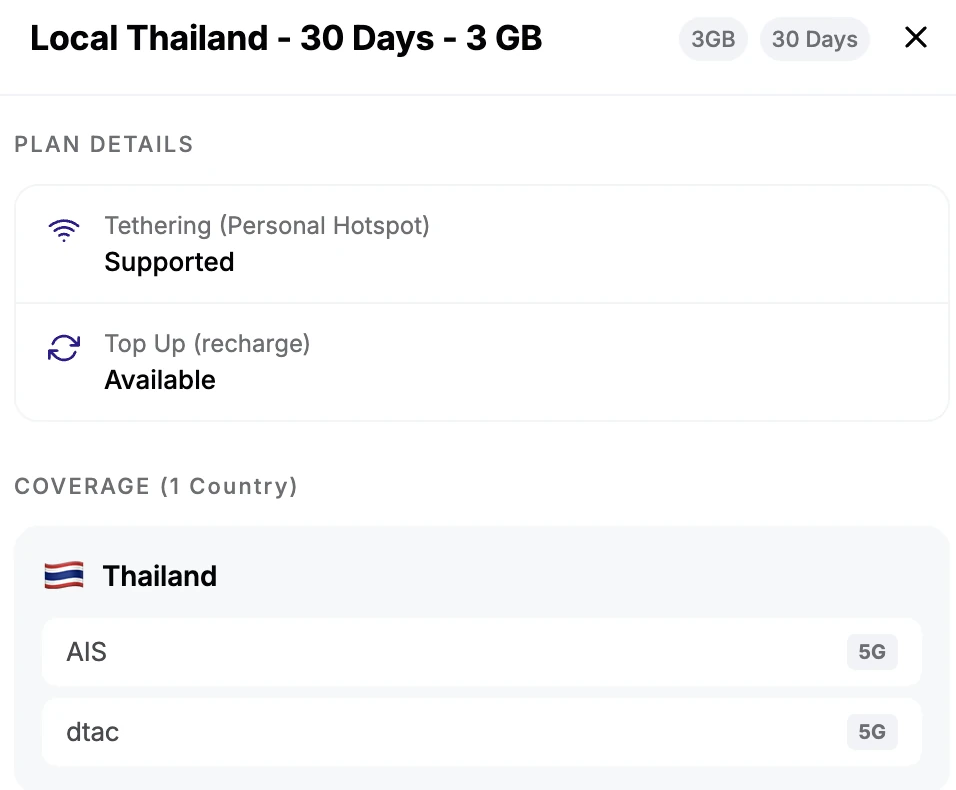
What can affect the data: like every travel eSIM, Nomad resells local networks, and which network you get varies by destination and sometimes by plan. In its strong destinations it rides first-tier carriers; elsewhere it can sit on a weaker network than a pricier rival uses in the same country. The plan page names the network, and checking it against the carrier’s coverage map is the two-minute step that decides whether the discount is free money or a false economy. That check is the backbone of our eSIM rankings, and it applies double to the budget option.
The honest wobble: reliability reports
No sugar-coating: 2026 Trustpilot reviews include a cluster of outage and connection complaints, with Japan named more than once. That does not undo the value story, and every reseller has bad weeks on some network somewhere, but it does mean Japan specifically is a destination where we would pick on network first and price second, exactly as our Japan guide does. If a trip has zero tolerance for connectivity failure, the boring default earns its premium; if a dropped hour is an inconvenience, the discount stays worth it.
Where Nomad is strongest
Asia is the honest answer. Thailand, Vietnam, Indonesia, Malaysia: this is where Nomad’s pricing is most aggressive and its network choices hold up, which is why it features in our Thailand guide and why the Vietnam guide takes it seriously. In Europe and the US it is competitive without being the obvious pick; the premium names’ network deals there are stronger, and the price gap narrows.
For multi-country trips its regional packs exist but are thinner than Airalo’s, so complex itineraries usually route back to the default. One plan, one country, lots of data: that is the Nomad-shaped trip.
Using Nomad well: buying tactics
Three habits get the most out of the value pick. Buy the big pack, not two small ones. Nomad’s pricing curve rewards size: the per-GB rate on a 15 or 20 GB pack routinely runs at half the rate of a 3 GB starter, so estimating high is cheaper than topping up twice. Data does not spoil; an unused 4 GB at the end of the trip cost you less than a mid-trip top-up bought at small-pack rates would have.
Watch the promotions page before a big trip. Nomad runs destination promotions constantly, and the difference between the standard price and the promoted one on the same pack can be substantial. Thirty seconds of checking before checkout is the best hourly rate on this page.
Validity windows matter more here than elsewhere. Every pack carries a validity period alongside its data amount, and the cheap large packs are only cheap if the window covers your trip. A 20 GB pack with 30-day validity on a 6-week stay quietly becomes two purchases. Match the window first, then the gigabytes, then the price.
Setup is the standard flow: install at home from the app (the iPhone walkthrough covers the five minutes), leave the line off until landing, then data line plus roaming on. Nomad is one of the providers where Android occasionally wants the APN typed manually, so keep the setup email findable.
Verdict
Buy Nomad if
- You need 10 GB or more and the per-GB math matters
- Your destination is one where it rides a first-tier network
- You are fine with a plain app in exchange for the price
Look elsewhere if
- You want unlimited data: that is Holafly’s territory
- Your itinerary spans many countries: Airalo’s regional plans are more mature
- The Nomad plan for your destination rides a network you would not choose
Nomad is what a value pick should be: cheaper for reasons you can see, with trade-offs you can check in advance. Do the network check, buy the big pack, and spend the difference on the trip. If you are still deciding between the whole field, the Airalo alternatives guide maps who beats the default at what.
FAQ
Is Nomad cheaper than Airalo?
Destination by destination it swings both ways, which is exactly why the per-GB check beats brand loyalty. Nomad’s big packs are often aggressive; its small starters are ordinary.
Does Nomad throttle speeds?
Fixed-GB packs run at full network speed until they run out. Where limits exist on unlimited-style products, the cap is printed on the plan card. The category rule stands: read the fair-use line before paying.
Can I hotspot with Nomad?
Yes, fixed-GB plans share freely; the gigabytes just vanish faster than phone-only usage suggests. Budget roughly double the moment a laptop joins the trip.