
Best eSIM for Bali (2026): The Telkomsel Question
By  Ignas Simkus|Last updated: 22 July 2026|How we test
Every Bali eSIM decision is secretly one question: does the plan ride Telkomsel or not? Answer that and the brand comparison mostly answers itself. This guide, built on the same plan-page checks we run for every destination, explains why, and which plans get you the right answer.
Article Summary
- The rule: for anywhere beyond the southern tourist strip, you want a plan riding Telkomsel, Indonesia’s widest network (~48% market share)
- The aligned pick: Nomad rides Telkomsel in Indonesia (~$19 for 10 GB): coverage pick and value pick in one
- Know this: Airalo rides Indosat and 3 here, not Telkomsel: fine for the south, not for the islands
- Long stays: Telkomsel’s own tourist eSIM (official packs ~25 GB / 30 days for about $10) is the value ceiling
Why one carrier decides Bali
Indonesia has three network groups that matter: Telkomsel, the state-adjacent giant with the deepest coverage, Indosat, and XL/Axis. On Java, in Denpasar, and along Bali’s southern strip, all three are fine. The gap opens exactly where Bali trips go: the inland roads around Ubud, the north and east coasts, Nusa Penida, and the crossing to the Gili Islands and Lombok. Out there, Telkomsel’s reach is a different product from its rivals’, and reports from travellers and coverage maps agree on the pattern.
This is the sharpest example anywhere of the rule our eSIM rankings are built on: the resold network decides your experience, not the app. In Bali the two answers diverge harder than almost any destination we cover.
The uncomfortable part: who rides what
The category default does not ride Telkomsel: Airalo’s Indonesia plans run on Indosat and 3 (Hutchison), which is fine across southern Bali and fades exactly where the trip gets good. That does not make it a bad buy; it makes it a southern-Bali buy. Our Airalo review calls this exact case out, because it is where the default most visibly stops being the right answer.
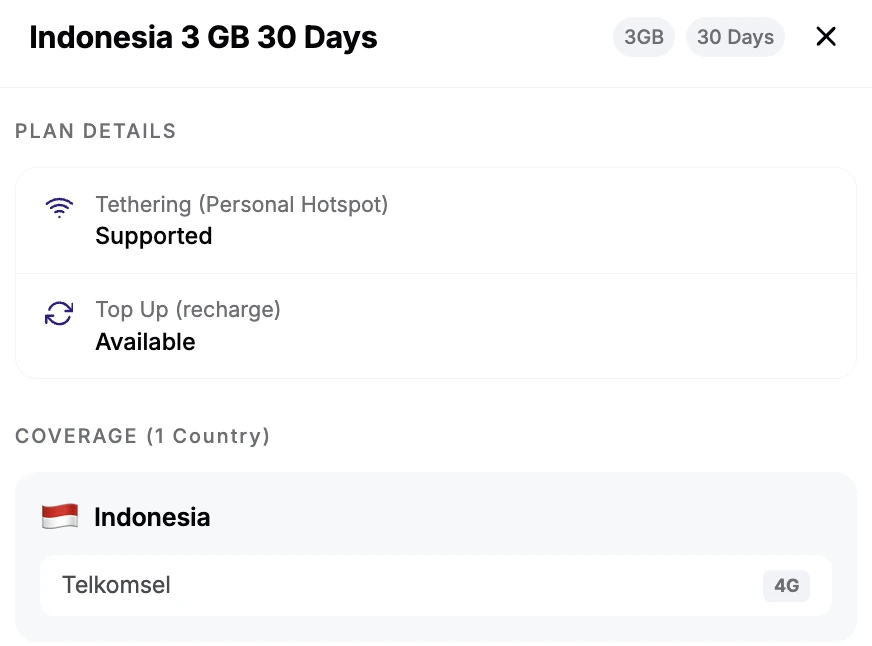
The good news for 2026: Telkomsel-riding eSIMs are no longer exotic. Nomad’s Bali and Indonesia plans ride Telkomsel, from around $19 for 10 GB, which makes the value pick and the coverage pick the same product here, a rare alignment. Among non-partner options worth knowing, Jetpac and Airhub also ride Telkomsel, and Telkomsel’s own tourist eSIM is the value ceiling for longer stays, its official WNA tourist packs run around 25 GB for 30 days at about $10, and some resellers bundle ~21 GB nearer $15. Whatever you buy, the check stays the same: the plan page’s supported-network line must say Telkomsel, because Telkomsel holds roughly 48% of the Indonesian market and the only network that reliably reaches Nusa Penida, the Gilis and the rural interior.
Matching the plan to the itinerary
| Your Bali trip | Buy | Why |
|---|---|---|
| Canggu/Seminyak/Uluwatu, beach and cafes | Any major eSIM (Airalo, Saily) | The south is covered by every network |
| Ubud + waterfalls + east coast | Nomad (rides Telkomsel) | Inland dropouts are where Indosat/XL fade |
| Nusa Penida / Gili / Lombok | Telkomsel, no debate: Nomad or the official tourist eSIM | Off the main island the gap is decisive |
| A month or longer | Telkomsel tourist eSIM (official ~25 GB/30d/~$10) or in-store SIM | Local rates beat any travel product |
Buying and setup, Bali-specific
Buy and install before you fly; Ngurah Rai airport has SIM counters, but they are the most price-inflated place on the island to get connected, and the official Telkomsel GraPARI stores in town offer the same products at local rates. The install itself is the standard five minutes, covered in our iPhone and Android walkthroughs, plus the usual landing routine of roaming on and the travel line set for data.
Data budgeting runs heavier than Europe: maps on scooter rides (whose insurance fine print deserves one read before you rent), translation, WhatsApp calls, and uploads push a normal user past 1 GB a day. A two-week trip wants 15 GB or a per-day unlimited plan; if that phrase is doing the deciding, read the fair-use reality in best unlimited eSIMs first.
And the standing advice everywhere applies here with extra force: if data dies mid-trip on a rural road, do not delete the eSIM to fix it. The fix checklist recovers almost everything; a deleted profile recovers nothing.
FAQ
Is the wifi in villas and cafes good enough to skip mobile data?
In Canggu and Ubud’s cafe belt, often yes for laptop work; Bali’s remote-work economy forced it. But the trip between wifi is where data earns its keep: scooter navigation, Gojek and Grab bookings, and the moment your driver needs to find a villa with no street address. Nobody regrets having data in Bali; plenty regret assuming.
eSIM or the airport SIM counter?
The counters at Ngurah Rai sell physical tourist SIMs at tourist prices, and the queue forms exactly when you least want one. The eSIM equivalent costs slightly less than the counter, is installed before you fly, and leaves your home SIM in place for bank codes, the arrangement our Android and iPhone guides set up in five minutes.
How much data for two weeks?
More than Europe: budget 1 GB a day. Navigation on every ride, translation, WhatsApp voice notes to the group, and nightly photo backup add up. A 15 GB plan is the comfortable buy; heavy uploaders should read the unlimited comparison first, daily caps included.
Does anything block WhatsApp or Instagram?
No; Indonesian internet is open for everything a visitor uses. The VPN case in Bali is the ordinary one, guesthouse wifi hygiene and home streaming, covered by any pick from the travel VPN ranking.
Does an eSIM work in the Gili Islands and Nusa Penida?
Yes, with thinner bars: the boats and far coasts are where Bali plans separate. Telkomsel-based plans hold on longest, so buy for the islands you plan to visit, not for Canggu, which everything covers.
Can I extend my eSIM if I stay longer in Bali?
On the major providers a top-up is a two-tap job in the app, no new QR. That convenience is worth more in Bali than almost anywhere, given how reliably two weeks becomes six.
Will my eSIM handle Grab and Gojek?
That is the primary use case and it works fine; both apps sip data. What actually kills ride pickups is dead zones at beach club car parks, not your plan. Wait where the bars are.