

Home»eSIM»Best eSIM for Mexico
Best eSIM for Mexico (2026): Check the Network Before the Price
By  Ignas Simkus|Last updated: 17 August 2026|How we test
Mexico is another one-carrier country wearing a three-carrier costume. Telcel covers the country; the others cover the cities and the highways between them. Whether your week is CDMX tacos or a Oaxaca road trip decides how much that difference matters, and which eSIM you should buy.
Article Summary
- The rule: beyond cities and resort corridors, you want a plan riding Telcel
- The 2026 surprise: Airalo’s own Mexico page currently lists Movistar as its primary network, so check the line before trusting any blog, ours included
- City-only trips: AT&T Mexico plans are fine and often cheaper
- Avoid: anything on Movistar for rural or coastal-road travel
One network covers Mexico; two cover parts of it
Telcel is Mexico’s dominant carrier with by far the widest footprint: cities, highways, small towns, and the rural stretches between beach and mountain that make the country worth driving. AT&T Mexico is genuinely decent in urban areas and along major corridors; Movistar trails both. The map only matters when you leave it, and Mexican itineraries leave it constantly: cenote detours, pueblo mágico weekends, the road to that one beach. The resold-network check from our eSIM ranking is the whole decision here.
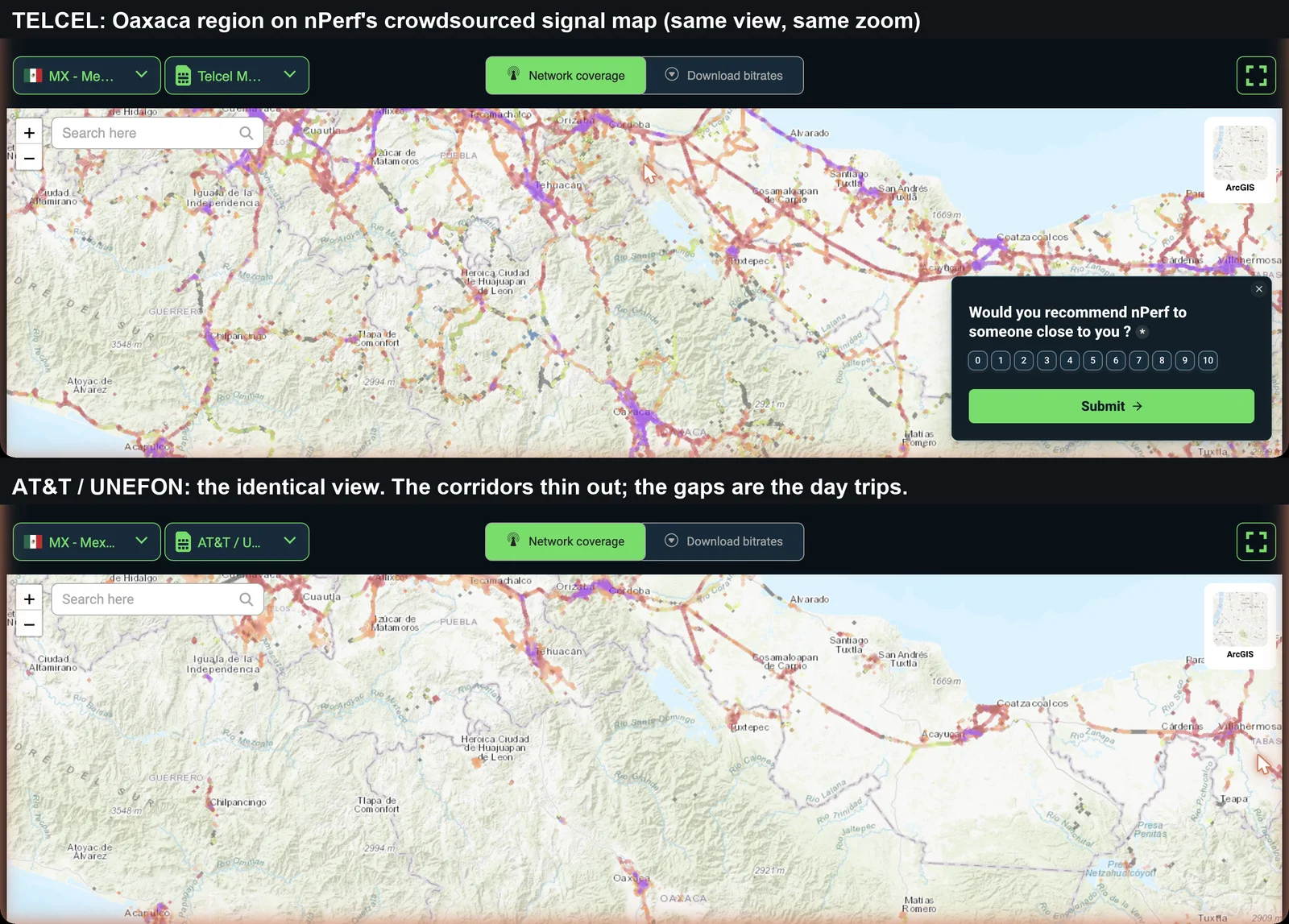
The official maps agree with the crowdsourced one: Telcel’s own coverage map claims by far the widest population footprint (industry trackers put it around 90%+ of the population), while AT&T Mexico concentrates on cities and corridors. You can replay our comparison yourself on nPerf’s Mexico map in thirty seconds: toggle the carrier layer and watch the back roads empty out.
The picks
One editorial note before the boxes, because it explains a ranking change. The internet’s default answer here is “Airalo, it rides Telcel”. When we pulled Airalo’s own Mexico page in July 2026, its network line listed Movistar as the primary network, plus one other. Movistar is the network our whole coverage rule avoids outside cities. Maybe that line changes back next quarter; the point is that the page, not the folklore, is the source of truth, and sixty seconds reading it beats every list on the internet, including this one. The trade-offs of the app itself still live in our Airalo review.
Saily
Honest grid pricing (1 GB at €4.04 to 20 GB at €36.89, July 2026), an in-app coverage map for Mexico, unrestricted hotspot on fixed packs and genuine 24/7 chat. Network printed in-app before purchase, which is exactly the habit this page preaches. App details in our Saily review.
Holafly
Unlimited data from €4.90 for a single day, sliding cheaper per day on longer plans, with the standing asterisk: hotspot sharing is capped around 1 GB a day. For one heavy phone living on video calls, it removes data anxiety entirely.
Nomad
Frequently the cheapest per GB at volume in 2026 comparisons (large packs have landed around $0.70/GB), with the caveat from our Nomad review doing double duty here: read the network line before paying, because value on the wrong network is no value at all.
Telcel’s own tourist SIM
The one option where the network question cannot go wrong, because it is the network. Airport counters and OXXO shops sell it; you pay in queue time and pesos rather than convenience. The section below covers when it is genuinely worth it.
What Mexico data costs right now
Pulled from the providers’ own grids, July 2026, EU storefront:
| Plan | Price | Per GB / per day |
|---|---|---|
| Saily 1 GB / 7 days | €4.04 | €4.04 per GB |
| Saily 5 GB / 30 days | €13.49 | €2.70 per GB |
| Saily 10 GB / 30 days | €19.79 | €1.98 per GB |
| Saily 20 GB / 30 days | €36.89 | €1.84 per GB |
| Airalo Unlimited / 3 days | €11.50 | €3.83 per day |
| Airalo Unlimited / 30 days | €53.50 | €1.78 per day |
| Holafly Unlimited / 1 day | €4.90 | €4.90 per day |
Mexico prices sit noticeably above Southeast Asia’s and a touch above Europe’s: the 1 GB/day appetite from the practicalities section below deserves a bigger pack than instinct suggests.
Matching plan to itinerary
- CDMX / Guadalajara city week: any major provider works; buy on price.
- Cancún-Tulum corridor: resort-zone coverage is universal, but day trips (Chichén Itzá, cenotes) reward Telcel.
- Road trips, Oaxaca, Chiapas, Baja: Telcel, no debate; long empty stretches are its home game.
- Digital-nomad month in CDMX/Playa: a big fixed pack on Telcel plus the cafe-wifi ecosystem; our unlimited guide maths applies if you hotspot heavily.
Mexico-specific practicalities
A 5G note first: Telcel and AT&T both run 5G in the big cities, and travel eSIMs increasingly inherit it, but outside metro areas you will live on 4G whoever you buy from, and coverage beats generation every single time. Data appetite runs high: navigation everywhere, WhatsApp voice notes as the national pastime, Uber/DiDi in cities, budget toward 1 GB/day like Southeast Asia rather than Europe’s lighter bands. WhatsApp is also how half of Mexican small business answers; a data-only eSIM covers it fully. And the standing rules travel with you: install before flying per the guide, keep your home SIM live for bank codes per the banking guide, and never delete a misbehaving eSIM, the checklist recovers almost everything.
The airport counter question
Telcel sells tourist SIMs at every airport, and unlike some countries the counters are legitimate, but you will queue after a red-eye to pay more than the eSIM you could have installed at home, for the same network. The only travellers who genuinely need the counter are those needing a Mexican number for local verification; everyone else lands connected.
FAQ
Is it safe to use my phone openly in Mexico City?
Big-city common sense applies: phones out in cafes and tourist zones are normal, waving one around on an empty street at night is the risk. The eSIM helps indirectly by deleting the airport SIM-shopping stop.
Do eSIMs work in Tulum and at the cenotes?
The Cancun-Tulum corridor is covered by everyone. The cenote circuits and back-road day trips are where Telcel-based plans keep their bars and the rest fade. Buy for the day trips, not for the hotel zone.
Can I make calls with a Mexico eSIM?
Travel eSIMs are data-only, and Mexico effectively runs on WhatsApp anyway, tours and restaurants included. Your WhatsApp number stays your home one; nothing changes for anyone messaging you.