

Cheapest eSIMs That Are Actually Usable (2026)
By  Ignas Simkus|Last updated: 19 August 2026|How we test
The cheapest eSIM in any country is usually one search away and frequently a mistake: wrong network, dead validity window, or support that answers next Tuesday. This guide is the price floor with the regret filtered out, where cheap is real, and where it is a coverage problem wearing a discount.
Article Summary
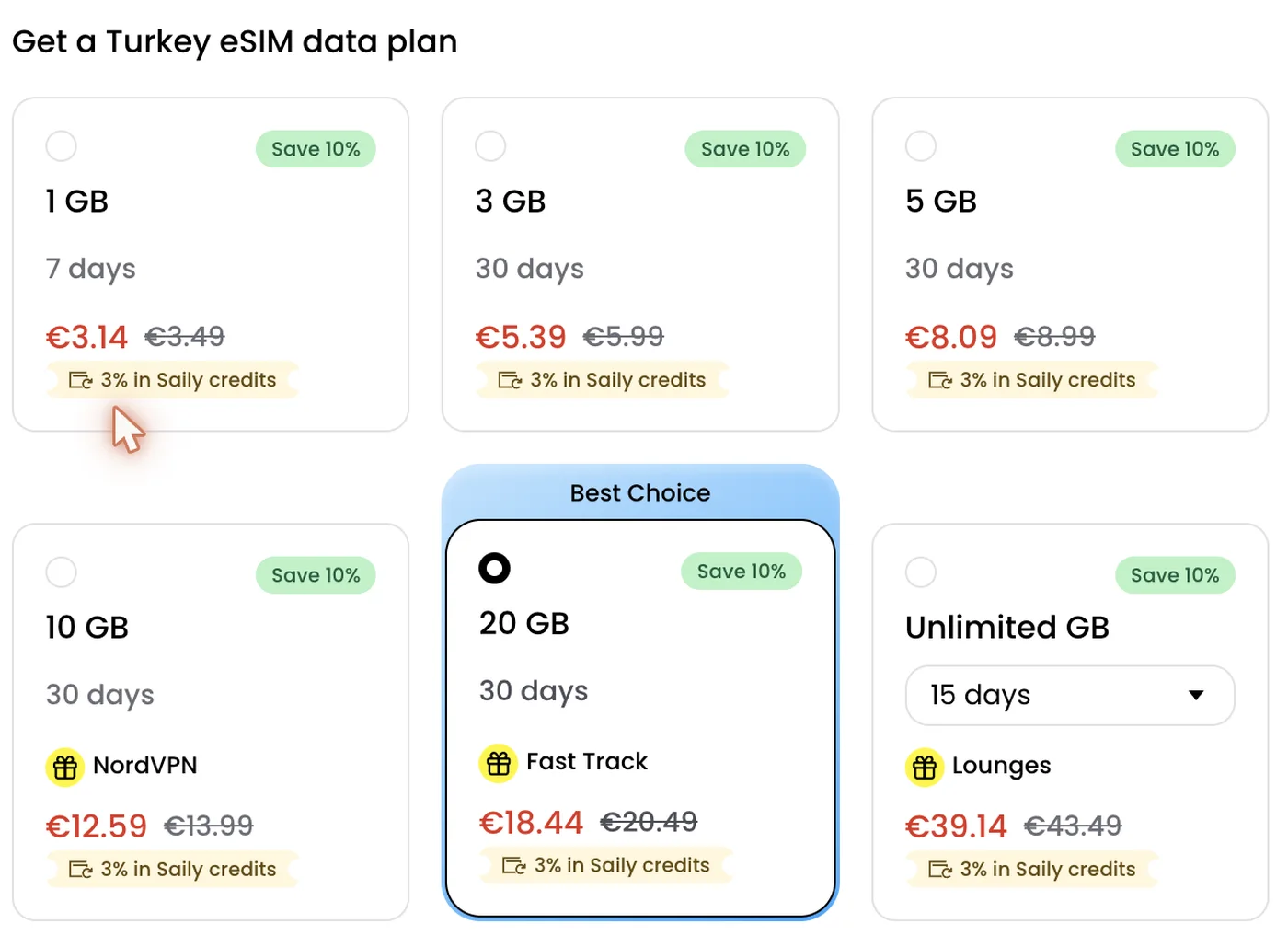
- Real floors: under a euro per gig on big packs in strong markets (Saily Turkey, July 2026: 20 GB at €18.44 is €0.92/GB against €3.14 for the 1 GB starter), mostly Nomad territory
- The three false economies: wrong network, short validity, tiny packs
- Cheap done right: big pack + verified network + validity that covers the trip
- Watch the promos: Saily and Nomad run constant destination deals
What cheap actually costs per gigabyte
The honest 2026 price floors: large packs in competitive markets bottom out around $0.5-0.7 per GB, Nomad’s Thailand 50 GB class and its Italy/Turkey routes live here, while mainstream defaults like Airalo run $2-4/GB on mid-size packs, and small starter packs everywhere cost $4+/GB because fixed costs dominate tiny denominations. Rule one of cheap: the discount lives in pack size, not provider magic. Buying 1 GB “to be safe” is the most expensive data you can buy.
| Real grid, July 2026 | Small pack | Big pack | Per-GB gap |
|---|---|---|---|
| Saily Turkey | 1 GB / €3.14 (€3.14/GB) | 20 GB / €18.44 (€0.92/GB) | 3.4x |
| Saily Mexico | 1 GB / €4.04 (€4.04/GB) | 20 GB / €36.89 (€1.84/GB) | 2.2x |
| Saily Europe (regional) | 1 GB / €4.04 (€4.04/GB) | 50 GB / 90 days / €76.90 (€1.54/GB) | 2.6x |
| Nomad large packs (2026 comparisons) | – | down to ~$0.70/GB at volume | – |
Sources: the providers’ own grids, e.g. Saily’s Turkey page, pulled July 2026. Same providers, same countries, same day: the only variable is pack size. That is the entire economics of cheap eSIM data in one table, and it is why “cheapest” headlines quoting a starter price are answering the wrong question.
The three false economies
- The wrong network at the right price. Bali on a non-Telkomsel bargain, Vietnam’s far north off Viettel, rural Mexico off Telcel, our destination guides exist because the cheapest plan on the weak network costs you the exact moments you travelled for.
- The validity trap. A 30-day pack on a 45-day trip is two purchases pretending to be one; check the window before the gigabytes.
- Support-free pricing. Rock-bottom resellers save their margin on the help desk; when activation fails at midnight, the savings evaporate. Our fix checklist rescues most of it, but a provider that answers, the majors all did in our support tests, under ten minutes each, is worth a dollar.
Where cheap is genuinely safe
Strong-network countries forgive budget picks: Japan and most of Western Europe run excellent networks across all carriers, so the cheapest reputable plan is simply the right buy, our Europe guide leans exactly this way. The discount rotation is real too: Saily and Nomad run constant destination promos, and thirty seconds checking both before checkout is the best hourly rate in this hobby. Regional plans price at a 20-40% per-GB premium; pay it for three-plus borders, skip it otherwise per the cost math.
The budget maximiser’s routine
- Estimate honestly. Last trip’s data counter, or 0.5 GB/day light, 1 GB/day normal, 2 GB/day if you hotspot or upload. Two weeks normal use: ~10-15 GB.
- Price two grids for your destination. Divide price by gigabytes on the pack that actually fits the estimate, not the headline starter.
- Check the network line. A cheap plan on the weak network fails the only test that matters; our destination guides list who runs what.
- Check validity against trip length. A 30-day pack on a 45-day trip is two purchases pretending to be one.
- Then, and only then, buy on price. Two brands passing all four checks are interchangeable; take the cheaper one without sentiment.
Ten minutes, and you will beat ninety percent of airport purchases by half.
Check Airalo → · Check Saily →
When not to cheap out
Remote-work trips where a dead connection costs a meeting: buy the boring default on the best network. One-day layovers: buy convenience, the absolute cost is coffee money. And anywhere our destination guides flag a single-network reality, Bali, Vietnam’s mountains, rural Mexico, the “expensive” right-network plan is usually $5-10 over the bargain. That is not a premium; that is the product.
FAQ
Are cheap eSIMs slower than expensive ones?
Price does not set speed; the resold network and local congestion do. A bargain plan on the strongest local network outruns a premium brand riding the weak one, which is why the network line matters more than the logo.
Why do eSIM prices differ so much for the same country?
Different wholesale deals, rotating promos, and starters subsidised to upsell bigger packs. That volatility is the argument for checking two or three grids before any trip; the winner rotates monthly.
Is my home carrier’s daily travel pass ever cheaper?
On a two-day hop, a flat daily pass can break even. Across two weeks it loses brutally to per-GB maths. Run the trip-length calculation once; the crossover arrives faster than carriers hope you notice.