


Home»eSIM»Best eSIM for Vietnam
Best eSIM for Vietnam (2026): Viettel Coverage Decides It
By  Ignas Simkus|Last updated: 22 July 2026|How we test
Vietnam is a long, thin country where the cities are easy and the good parts are remote. That geography makes the network question unusually simple: Viettel reaches where the others thin out, and your eSIM either rides it or it does not.
Article Summary
- The rule: leaving the cities? You want a plan riding Viettel, the widest network by a distance
- Best value: Nomad‘s Vietnam packs, aggressive per-GB pricing in its strongest region
- Safe default: Airalo, check the network line for your plan
- City-only trips: Hanoi, Da Nang, Ho Chi Minh City work on everything
Vietnam’s network map, in one paragraph
Three carriers matter: Viettel, the military-owned market leader whose coverage obligation reaches the mountain provinces and the islands, then Vinaphone and MobiFone, both solid in cities and along the main coastal corridor. In Hanoi, Ho Chi Minh City, Da Nang and Hoi An, all three are excellent and 5G is spreading fast. The gap opens on the Ha Giang loop, in the far north generally, on the inland stretches between coastal towns, and on Phu Quoc’s quieter sides: that is Viettel territory, and travellers running the loops report the difference plainly.
So the buying rule is the standard one, applied firmly: open the plan page, read the supported-network line, and match it to your itinerary. City break, ignore this entirely. Motorbike loop, it is the whole decision, the same coverage-first logic our eSIM rankings apply everywhere.
The picks
Nomad
Southeast Asia is Nomad’s strongest region and Vietnam pricing follows: large packs at per-GB rates the premium names do not match. Verify the network on your plan, then buy big. Trade-offs in the Nomad review.
Airalo
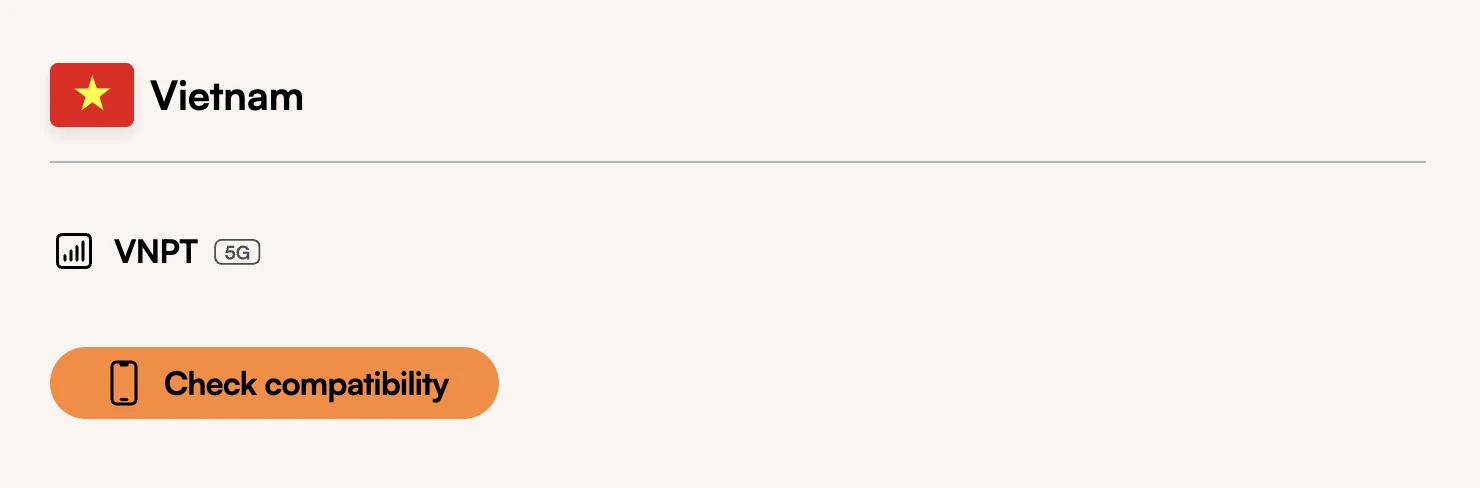
Airalo’s Vietnam plan rides VNPT with 5G, we checked the plan page ourselves, from $4.50 for 1 GB / 7 days. VNPT (the VinaPhone network) is a solid nationwide second, easily enough for the classic coast-and-cities route; if the Ha Giang loop or the far north is the point of the trip, buy a plan that rides Viettel instead.
eSIM vs the local SIM counters
Vietnam’s local SIM market is famously cheap: tourist SIMs with big allowances cost very little at official Viettel or Vinaphone stores. The airport counters at Tan Son Nhat and Noi Bai are pricier and busier, and unofficial street vendors sell SIMs that sometimes die when registration rules catch up with them, Vietnam requires ID registration for local SIMs, so buy only from official stores if you go local.
The travel eSIM trades a few dollars for skipping all of that: no counter, no passport handover, home SIM intact, connected at baggage claim. For trips under a month we take that trade, the same arithmetic as everywhere in the eSIM vs roaming vs local SIM math. Past a month, an official Viettel tourist plan is the value ceiling and worth the store visit.
Setup notes for Vietnam specifically
Install at home before flying, the standard five minutes on iPhone or Android. Two Vietnam-specific notes. First, data budgeting: Grab, maps, translation and photo backup push usage past 1 GB a day for most travellers, so a two-week trip wants 10 to 15 GB. Second, if you are doing a loop, download offline maps for the whole route before leaving the city; even Viettel has dead valleys, and offline maps turn them from a problem into a non-event.
Landing routine as always: travel line on, set as data, roaming on. If nothing flows, the 10-minute checklist fixes the usual suspects, and manual network selection onto the carrier your plan actually uses is the Vietnam-specific step worth knowing about, because phones sometimes latch onto a partner network with no data agreement.
Last practical note: Vietnamese immigration and e-visa checks occasionally want your accommodation address on arrival, and that address lives in a booking app that needs data you do not have yet. Screenshot the first night’s booking before boarding. It is a ten-second habit that has rescued more arrivals than any amount of network engineering.
FAQ
Is data expensive in Vietnam?
No; it is among the cheapest in the world per gigabyte, which is why even the travel-eSIM markup lands at prices that feel like rounding errors. This is not a destination to suffer roaming charges in, a point the cost-math comparison makes with numbers.
Do I need a Vietnamese phone number?
Mostly no. Grab, the ride-and-food app that runs traveller life in Vietnam, accepts foreign numbers for registration, something we have verified on the ground in Vietnam, and hotel bookings run on WhatsApp or email. The exception is domestic services like local delivery apps, which most visitors never touch. Data-only eSIMs cover the actual trip.
What about the trains and the sleeper buses?
Coverage along the main north-south corridor is solid on all carriers; the gaps are in the mountain passes, and they are brief. Download entertainment beforehand anyway; tunnel-heavy stretches do what tunnels do.
Two weeks, how much data?
Ten to fifteen gigabytes for a normal heavy user. Vietnam pushes usage up: Grab all day, translation apps in every market, photo backup of a photogenic country. Buy the bigger pack; at Vietnamese per-GB prices the insurance costs almost nothing.
Which network is best for Ha Giang and Sapa?
The mountains are Viettel country, full stop. VNPT-based plans are fine for cities and the coast; if the northern loop is the point of the trip, buy specifically for Viettel coverage.
Does data work on Vietnamese trains and sleeper buses?
The north-south line and the sleeper buses spend real time in coverage gaps, and that is the geography, not your plan. Download entertainment and offline maps; signal returns near towns.
Can I just buy an eSIM at the airport in Vietnam?
You can, at a markup, with a queue, after a long flight. The entire point of the eSIM is making that counter optional: install at home, land, toggle, Grab to the hotel.